Blog

  • Daily Market Update: 22 October 2025

    Daily Market Update: 22 October 2025

    All Ords (ASX:XAO) resets record high, Alcoa (ASX:AAI) rare earth miners surge on US deal

    The Australian share market retested its intra-day all-time high on Tuesday, ultimately gaining 0.7 per cent amid a broad-based rally triggered by a huge US-Australian rare earth deal and strong US earnings reports from the likes of Apple (NYSE:AAPL). The materials sector finished more than 1 per cent higher, and retailers 1 per cent as likes of the BHP (ASX:BHP) and Super Retail (ASX:SRL) rallied strongly. BHP gained 2.3 per cent after the company flagged expectations that global demand for iron ore showed no signs of slowing in the long-term, while also delivered record mining production in its core iron ore business. But it was all about rare earths, as Alcoa (ASX:AAI) and Ararfura (ARU) bounced strongly following an agreement between the US and Australian governments to support the domestic rare earth mining sector. The focus remains on competing with the very low cost Chinese suppliers, with $1 billion each to be invested into Australian companies in the next six months as a starting point. 

    Super Retail (ASX:SRL) rallies on leadership change, Cleanaway (ASX:CWY) hit by remuneration strike, Hub 24 surges on inflows

    Cleanaway Waste Management (ASX:CWY) shares fell sharply, down 4 per cent, after the company received 40 per cent of votes at its AGM against its remuneration and bonus report. This was a direct result of a string of deaths at work sites over the last 12 months. The group did, however, reaffirm expectations that profit will sit between $470 and $500 million for the 2026 financial year. Super Retail gained after the company announced the appointment of BCF managing director Paul Bradshaw as the new CEO, following successes with the outdoor equipment business. Super platform Hub 24 (ASX:HUB) gained more than 10 per cent after the company reported an 8 per cent increase in funds under administration on its platform, to $122 billion, 33 per cent higher than a year ago, as 41 new distribution agreements were signed. While Droneshield (ASX:DRO) gained more than 8 per cent after a weeklong sell off, as the popular trading stock continued its incredible rally.

    Dow nears record, as gold sinks, Coca-Cola (NYSE:KO) rallies on sales growth, Netflix earnings ahead

    The Dow Jones led the way overnight, gaining 0.6 per cent, with the S&P500 and Nasdaq both lagging despite positive news on the US-China trade front. The gold and silver price fell steeply on hopes that the trade and geopolitical turmoil will settle, as investors far and wide have been pouring into the precious metal. Shares in Coca-Cola (NYSE:KO) were 4 per cent higher after the company reported 6 per cent sales growth, incredibly strong for such a mature business, as a widening portfolio of drinks, including more sugar-free options increases the target market and sales potential. Warner Bros Discovery (NYSE:WBD) rallied by more than 10 per cent as the company flagged intentions to break up its business with the likes of Netflix (NYSE:NFLX) and Comcast among the interested parties.

    Australian IndicesDaily %Weekly %1 Month %3 Month %1 Year %
    ASX 2000.72.23.76.014.4
    Financials0.42.72.45.619.8
    Resources1.30.110.116.816.8
    Information Technology0.5-0.5-3.8-0.718.9
    Global IndicesDaily %Weekly %1 Month %3 Month %1 Year %
    US 5000.01.02.57.319.4
    Europe0.61.63.85.524.0
    Japan4.44.314.727.9
    China top 501.41.4-1.45.232.6
    India top 500.43.03.20.42.8
    Fixed InterestDaily %Weekly %1 Month %3 Month %1 Year %
    Australian Treasury Bond0.20.61.01.86.4
    Australian Corporate Bond0.00.61.01.97.0
    US Treasury0.20.31.13.34.3
    Cash0.00.10.31.04.2
    Commodities & CryptoDaily %Weekly %1 Month %3 Month %1 Year %
    Gold-5.52.79.927.049.9
    Silver-7.30.110.134.836.7
    Crude Oil-0.2-2.1-7.8-10.8-19.5
    Bitcoin-2.40.6-1.6-5.270.2
  • Daily Market Update: 21 October 2025

    Daily Market Update: 21 October 2025

    ASX recovers from weak opening, technology, banks rally beyond Comm Bank (ASX:CBA), Newmont (ASX:NEM), gold miners sink

    The local sharemarket managed to turn a weak start into a positive day, finishing 0.4 per cent higher on Monday, after posting a record high the week prior. Nine of the 11 sectors managed a gain, led by the Big Four Banks and real estate, which added more than 1 per cent each. Commonwealth Bank (ASX:CBA) has found support after a weak period of trading, posting a 2.6 per cent gain. It was good news on the economic front in China, with the economy having grown by 4.8 per cent in the last 12 months, around the 5 per cent growth target, and amidst an increase in tariff rhetoric from President Trump. PM Albanese is set to meet Trump this week to discuss policy changes that would support Australia’s rare earth mining expansion plans. Gold miner reversed the best week in five years, as the price of bullion retreated, pushing Newmont (ASX:NEM) down close to 6 per cent for the session. 

    Bapcorp (ASX:BAP) drops sharply on operational issues, Zip (ASX:ZIP) surges on US sales growth

    Auto parts group Bapcorp (ASX:BAP) has seen its woes continue with shares tanking by more than 17 per cent after the company delivered a sharp downgrade to earnings expectations. The group flagged a $12 million hit due to “unsatisfactory operational practices” in its tools and equipment focused Trade division. Full year net profit is now expected to be just $3 to $7 million, with a review of the business model flagging the need for immediate management changes in an effort to recover flagging margins, as the challenge of integrating acquired businesses comes to the fore. BNPL group Zip Co (ASX:ZIP) have rallied by more than 4 per cent after the company confirmed strength in US sales, as transactions increased by 51 [er cent to $3 billion in the first quarter. The company is now pursuing a Nasdaq listing, on the back of a cash earnings hitting $63 million for the quarter and continues to keep bad debts under control. Uranium miner Deep Yellow (ASX:DYL) has fallen by close to 19 per cent following the shock resignation of CEO John Borshoff.

    US indices rally, Apple hits record, Amazon weathers outage, rare earths deal signed

    Shares in Apple (NYSE:AAPL) joined the record high party, hitting their first record of 2025, well behind competitors like NVIDIA (NYSE:NVDA) as demand for the new series of iPhones looks to be 14 per cent better than the prior release; shares rallied 4 per cent on the update. All eyes are on earnings season with Tesla (NYSE:TSLA) among the companies set to report this week, as 85 per cent of companies already reporting have beaten expectations. It was good news for markets as US-China trade talks are expected to include conversations about Taiwan, with the result being a 1.1 per cent gain in the Dow Jones and S&P500, buoyed by smaller companies, with the Nasdaq adding 1.4 per cent. Amazon (NYSE:AMZN) shares gained 1 per cent despite a global outage that sent everything from Zoom to Xero down briefly around the world. Kering  SA announced plans to sell its beauty division to L’Oreal in a US$4.7 billion deal, while Worldpay and Global Payments Inc are set to create a payment processing giant after passing competition regulator in the UK. Finally, the US-Australia signed a basic agreement that will see more support for Australian rare earth exports to the US, as they seek to reduce reliance on China.

    Australian IndicesDaily %Weekly %1 Month %3 Month %1 Year %
    ASX 2000.41.73.04.211.8
    Financials1.50.71.01.615.9
    Resources-1.03.511.418.916.7
    Information Technology1.3-1.9-4.3-2.617.2
    Global IndicesDaily %Weekly %1 Month %3 Month %1 Year %
    US 5001.10.61.96.818.4
    Europe-0.11.43.35.322.7
    Japan1.80.72.013.523.3
    China top 501.2-1.5-3.34.030.2
    India top 500.42.52.70.20.9
    Fixed InterestDaily %Weekly %1 Month %3 Month %1 Year %
    Australian Treasury Bond-0.30.70.81.75.4
    Australian Corporate Bond-0.20.70.81.86.2
    US Treasury-0.40.40.93.24.0
    Cash0.00.10.31.04.2
    Commodities & CryptoDaily %Weekly %1 Month %3 Month %1 Year %
    Gold-2.93.617.326.658.2
    Silver-4.66.030.342.062.9
    Crude Oil0.4-3.2-7.6-10.7-7.1
    Bitcoin1.1-2.5-2.8-5.868.7

  • Cracking the code: Incorporating alternatives into managed accounts

    Cracking the code: Incorporating alternatives into managed accounts

    The push to integrate alternative investments into managed accounts is gathering momentum, but implementation remains a sticking point. Christian Ryan, founder of FinCap and a long-time participant in the advice ecosystem, believes the key to unlocking alternatives in SMA structures lies in simplicity, alignment and innovation.

    Having spent nearly two decades working with managed accounts, Ryan notes that adoption has already reached a critical mass. “Over 70 per cent of firms now are using managed account structures, either in full or in part, to manage their assets,” he says. “They’re great products, great ideas. But the challenge has been implementing alternatives, especially private markets, properly.”

    The complexity of administering private assets within SMAs, particularly with respect to liquidity, has made many advisers reluctant to engage. “Private markets have been a fundamental problem for a lot of firms to actually solve, and do it properly,” Ryan says. “How do I create liquidity? How do I administer it in a way that makes sense for clients and advisers alike?”

    To address this, FinCap is developing a dedicated technology platform that Ryan hopes will allow advisers to access private equity and infrastructure strategies through an SMA framework. “There’s a lot of great strategies, a lot of deep thinking,” he says, “but most advisers probably only spend 10 per cent of their time thinking about investments. The rest is clients, tax, cash flow. We want to help them actually run these strategies with minimal friction.”

    For Ryan, the beauty of the SMA is that it’s fundamentally an implementation structure. “If you can get the client ownership as close as you can to the asset, you’re more likely to deliver the best net return,” he says. But to do this, the structure must remain clean, transparent and cost-effective. “Advisers like simplicity. They like transparency. If we can keep some of the structures out of the cost stack – feeders, wraps, hidden layers – that’s a win for the client.”

    Legacy platforms are struggling to adapt. “They’ve done a great job across a whole range of things,” Ryan concedes, “but when it comes to private assets via managed accounts, they’re stuck. Their technology is 15 years old, and they’d have to spend a lot to change that. They’re still growing and enjoying rising share prices, so why would they?”

    By contrast, FinCap’s aim is to create a purpose-built infrastructure for private assets. “We’re wrapping resources around a treasury function that helps with liquidity,” Ryan explains. “The goal is to create a private-asset marketplace, a structure where people can trade and net-off positions, like a platform does today.”

    For Ryan, the ability to monitor managers closely is critical, especially in private equity and operating real estate. “When you’re buying a business, you do legal, financial, commercial and operational due diligence. It’s the same with fund managers. You’re investing in those people, and as a fiduciary, that personal sense of responsibility matters.”

    What distinguishes the SMA structure, he says, is the flexibility it gives to move between managers, funds and even asset classes. “In a diversified portfolio across equity, real estate and infrastructure, if something changes, you can actually act. You’re not trapped. And that’s important, especially in property, which takes months to transact. There’s a big market, but it’s illiquid. The SMA helps bridge that.”

    That flexibility is what Ryan believes will make managed accounts a permanent home for alternatives. “There are so many different strategies, so many different assets, and it’s much bigger than the listed world,” he says. “Alternatives are part of everyone’s life already – a property here, a business there – but until now it’s been hard to bring them into portfolios efficiently.”

    Ultimately, the challenge is part structural, part cultural. “It’s not just about technology,” Ryan says. “It’s about making the whole experience simpler and more intuitive, for advisers and their clients. If we do that, managed accounts could become the best vehicle we have to access the full range of alternative investments.”

  • Currency as protection: Why FX belongs in the portfolio

    Currency as protection: Why FX belongs in the portfolio

    “You all have currency,” said Andrew Harrex, managing director of P/E Investments. “If you invest overseas, you are already investing in currency. Most just don’t think of it that way.”

    Speaking at The Inside Network’s Alternatives Symposium, Harrex challenged advisers to reconsider how they view international exposure. “Think of your global equity portfolio. It’s actually two portfolios,” he said. “There’s the underlying equities, and then there’s the currency. On average, 30 per cent of your total equity return comes from currency.”

    That currency exposure, he argued, is too important to leave unmanaged. “You are allocating 18 per cent to equities and 7 per cent to global currencies, not 25 per cent to equities,” he said. “That’s just the data. My question is: what are you doing about it?”

    What most clients want, Harrex said, is not simply diversification, but true downside protection. “People say they want uncorrelated assets. But what they really want is something that’s negatively correlated when equities fall. Isn’t that what they actually mean?”

    The data bears this out. Looking at six equity drawdowns over the past 25 years on the ASX, Harrex compared how various asset classes performed during periods of 10 per cent or greater equity market declines. “Bonds haven’t consistently protected portfolios. Private markets, trend-following, gold, none gave reliable downside protection.”

    The standout was currency. “The average equity drawdown across those six periods was 20 per cent,” Harrex said. “Our active FX strategy returned 13 per cent across those same periods. That’s a downside capture ratio of 66 per cent.”

    For advisers searching for protective assets that do not erode long-term returns, that is a compelling case. “There is no perfect asset, only put options give you perfect protection,” Harrex said. “But currency was the best-performing asset in down markets. And over the full cycle, it gave you equity-like returns.”

    The rationale is straightforward. “This active FX strategy is essentially a global macro strategy,” he explained. “It picks up on macro themes, and there’s always a reason why equities fall. This gives you a better chance of protecting the portfolio when they do.”

    It also addresses a growing structural issue. “The historical bond-equity correlation has broken down,” Harrex said. “For 25 years, bonds offered negative correlation. But since 2020, it’s flipped. Now the correlation is positive.”

    That shift has profound implications. “We looked at inflation levels,” Harrex said. “When US inflation is above 2.5 per cent, the bond-equity correlation is positive. When it’s below 2 per cent, it’s negative. Our view is inflation is going to stay high. That positive correlation is here to stay.”

    In light of that conviction, Harrex believes FX deserves a seat at the core of portfolios. “One of our clients described it as positive-carry portfolio insurance,” he said. “I like that. Because it tends to go up when equities go down, but unlike traditional insurance, it doesn’t cost you each month.”

    He illustrated this with a reallocation of a standard 60/40 portfolio. “We replaced 20 per cent of the bonds with our FX strategy,” he said. “That shift increased annual returns by 1.2 percentage points, with the same volatility. A better portfolio by every metric.”

    For those using private assets, the argument still holds. “We added a variety of private assets to the mix and ran the efficient frontier,” Harrex said. “Then we added FX. Not only did it move the frontier up and left – lower volatility, higher return – it blended better with other assets than almost anything else.”

    The final takeaway? Advisers must think beyond Sharpe ratios. “Sharpe is about reducing volatility,” he said. “Bonds have the best Sharpe ratio, but is 100 per cent bonds what your client wants? Probably not. The Sortino ratio, which focuses on downside protection, tells a more relevant story for portfolios. FX ranks exceptionally well there.”

    Harrex concluded with a simple request. “Throw away what you thought you knew about currency,” he said. “At least explore what active FX can do in a portfolio. See the difference for yourself.”

  • 16 years searching for true diversification

    16 years searching for true diversification

    Diversification used to be simple. Equities delivered growth, bonds supplied income and stability, and the relationship between the two, often negative in times of stress, acted as a natural hedge. But in 2022, that balance cracked: both asset classes fell sharply, erasing trillions from portfolios and challenging the very premise of diversification. If the classic model no longer guarantees resilience, where should investors turn? The answer lies in uncorrelated assets.

    Correlation is the mathematical expression of how two investments move in relation to each other. A correlation of +1 means perfect synchronisation, while -1 implies they move in opposite directions. In practice, most traditional investments sit somewhere in the middle – positively related, though imperfectly. The goal of diversification is not just to hold a wide array of assets but to combine return streams that move differently across economic regimes. It is the independence of returns, not the quantity of holdings, that delivers true protection.

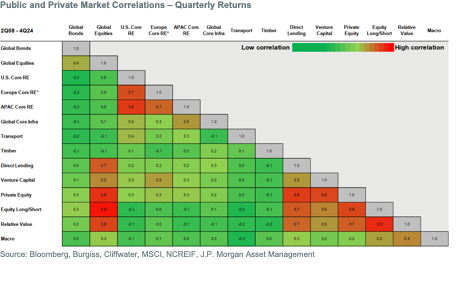
    Data from J.P. Morgan, covering 2008 to 2024, shows that global equities and private equity exhibit a correlation of 0.80 – near lockstep. Venture capital is not far behind. Even global bonds, long considered the equity counterweight, show a positive correlation of 0.4 with equities over this period. These figures highlight a crucial point: many investors are less diversified than they believe. A portfolio loaded with equities, private equity and credit may appear broad on paper, but its fate is tethered to a single driver – global growth risk.

    By contrast, certain alternative assets demonstrate correlations close to zero, or even negative, against traditional markets. Infrastructure, such as airports, utilities and transport networks, shows correlations near zero with both equities and bonds. Its revenues are tied to long-term contracts and essential services, not market sentiment. Timberland exhibits a similar profile, reflecting biological growth cycles and resource demand rather than financial market dynamics. Transport assets, such as shipping, ports, and logistics facilities, also display negligible correlation: the fortunes of these assets are tied to trade flows and physical movement of goods. Even within hedge funds, macro strategies stand out, with correlations close to zero, thanks to their ability to profit from volatility, interest rates or currencies rather than equity beta.

    The importance of these uncorrelated exposures cannot be overstated. In a world where equities and bonds may both falter in the face of inflation or fiscal stress, assets with independent return drivers provide ballast. They don’t just smooth the ride – they redefine resilience by ensuring that not all components of a portfolio bend to the same pressure.

    Yet achieving true diversification is not without pitfalls. Investors often fall prey to superficial diversification, mistaking variety for independence. Holding global equities, private equity and venture capital may feel like a broad mix, but the correlation matrix shows they are variations of the same theme. Another trap is ‘correlation creep,’ where assets that seem diversifying in normal times converge under stress, leaving portfolios exposed when protection is most needed. Finally, the allure of illiquidity can disguise risk: private markets report valuations infrequently, which may mask their true sensitivity to broader market shocks.

    The path forward requires discipline. Wealth groups and institutions must design portfolios around economic drivers rather than asset labels. That means combining growth-sensitive assets (equities, private equity) with inflation-linked real assets (infrastructure, timber, real estate) and strategy-based diversifiers (macro hedge funds). It also means striking a careful balance between liquid and illiquid exposures to ensure flexibility without sacrificing long-term return premiums.

    The diversification once promised by the 60/40 portfolio has eroded, and simply adding more equity-like assets does not solve the problem. As the J.P. Morgan correlation data demonstrates, genuine resilience requires deliberately combining assets whose return streams are structurally uncorrelated with traditional assets.

    This is where the breadth of alternative investments comes into focus. Infrastructure provides contracted, inflation-linked revenues from airports, utilities and hospitals. Natural resources such as timber and farmland follow biological and commodity cycles rather than market sentiment. Hedge funds, particularly macro, currency and multi-strategy funds, monetise volatility and dislocations rather than relying on equity beta. Private equity and private debt open opportunities beyond listed markets, although their correlations must be carefully assessed. Real estate offers both direct and indirect exposure, with specialist sectors like logistics and healthcare facilities increasingly evolving into core allocations. Even other alternatives – tangible assets like fine wine, art, collectible watches, and automobiles, or intangible ones such as patents, music royalties, and digital assets (crypto, NFTs) – remind investors of the vast spectrum of non-traditional return drivers.

    The key takeaway is that alternatives are not a single block, nor are they all equally diversifying. Some, like private equity, remain equity-sensitive. Others, like infrastructure or timber, move to an entirely different rhythm. The challenge for investors is to look through the labels and identify those exposures that truly add independence to portfolios. True diversification is not about owning more of the same – it is about blending uncorrelated assets that ensure portfolios bend, rather than break, when the next shock arrives.

  • Reimagining income and defensive portfolios: INDepth with Lauren Ryan from Thinktank

    Reimagining income and defensive portfolios: INDepth with Lauren Ryan from Thinktank

    Relying solely on public bond markets for your defensive income-bearing allocation is now well-understood as too risky, Lauren Ryan from Thinktank tells Laurence Parker-Brown from The Inside Network, as she goes INDepth on reimagining income and defensive portfolios.

  • Daily Market Update: 20 October 2025

    Daily Market Update: 20 October 2025

    ASX retreats despite weekly gain

    The Australian sharemarket ended lower on Friday, with the S&P/ASX 200 Index (ASX: XJO) falling 0.8 per cent to 8,995.3, after reaching a record high above 9100 in the previous session. Despite the pullback, the index still posted a 0.4 per cent gain for the week. The broader All Ordinaries Index (ASX: XAO) also dropped 0.9 per cent. Losses were widespread, with eight of the 11 sectors declining, led by energy and technology stocks. Notably, Life360 Inc (ASX: 360) tumbled 8 per cent to $45.54, marking its largest one-day loss since April.

    Critical minerals slump amid policy doubts

    Commodity-related companies saw mixed fortunes, with gold miners rallying as the precious metal reached a new all-time high of $US4378.69. Newmont Corporation (ASX: NEM) rose 2.9 per cent to $149.96, while Northern Star Resources Limited (ASX: NST) gained 2.3 per cent to $26.05. However, shares in copper, lithium, and rare earths companies fell ahead of Prime Minister Anthony Albanese’s meeting with the US President, which will include discussions on critical minerals. Market scepticism over the Australian government’s strategy to stockpile these resources weighed heavily on stocks such as Lynas Rare Earths Limited (ASX: LYC), down 5.7 per cent, and Paladin Energy Limited (ASX: PDN), down 6.8 per cent. Meanwhile, Iluka Resources Limited (ASX: ILU) dropped 2.4 per cent after withdrawing its sales forecast due to issues with a key customer. Among the major miners, BHP Group Limited (ASX: BHP) dipped 0.4 per cent, while Rio Tinto Limited (ASX: RIO) rose 1.3 per cent. The financial sector also struggled, with QBE Insurance Group Limited (ASX: QBE) plunging 9.3 per cent and both National Australia Bank Limited (ASX: NAB) and Westpac Banking Corporation (ASX: WBC) falling 0.8 per cent.

    Global gold rally and US equities rise

    Internationally, gold demand surged in Asia, particularly in India, where premiums hit a decade-high as buyers prepared for Dhanteras and Diwali festivals. Spot gold exceeded $US4300 per ounce for the first time, driven by heightened US-China trade tensions and expectations of a US interest rate cut. In equity markets, the S&P 500 Index gained 0.5 per cent.

    Australian IndicesDaily %Weekly %1 Month %3 Month %1 Year %
    ASX 200-0.80.42.05.212.1
    Financials-1.20.61.74.018.0
    Resources-0.43.59.721.418.6
    Information Technology-2.2-4.9-4.8-1.915.5
    Global IndicesDaily %Weekly %1 Month %3 Month %1 Year %
    US 5000.51.73.15.117.8
    Europe0.62.85.35.222.9
    Japan-0.21.83.312.522.7
    China top 50-1.2-0.4-1.47.431.4
    India top 500.32.63.3-1.01.0
    Fixed InterestDaily %Weekly %1 Month %3 Month %1 Year %
    Australian Treasury Bond0.31.40.92.05.9
    Australian Corporate Bond0.31.20.92.16.6
    US Treasury0.51.20.83.94.4
    Cash0.00.10.31.04.2
    Commodities & CryptoDaily %Weekly %1 Month %3 Month %1 Year %
    Gold3.47.818.727.861.4
    Silver2.95.031.739.769.4
    Crude Oil-2.5-2.5-9.7-11.2-5.5
    Bitcoin-1.8-12.0-6.5-11.758.1

  • INSight #456 with Rob Hinchliffe from PineBridge Investments

    INSight #456 with Rob Hinchliffe from PineBridge Investments

    Rob Hinchliffe from PineBridge Investments speaks to James Dunn from The Inside Network on the segmentation of the market by lifecycle categories vs sectors.

  • Daily Market Update: 17 October 2025

    Daily Market Update: 17 October 2025

    Banks, fund managers and gold lift, whilst rare earths fall

    The S&P/ASX 200 (ASX: XJO) reset an intraday record, climbing to 9,109.7 points before closing at 9,068.4, as a surprisingly weak labour force report – unemployment rising to 4.5 per cent – jolted markets into pricing in a likely Reserve Bank of Australia rate cut. Domestic banks and real estate stocks led the charge: Commonwealth Bank (ASX: CBA) +0.8 per cent, ANZ Banking Group (ASX: ANZ) +1.9 per cent, Goodman Group (ASX: GMG) +4.9 per cent, Mirvac (ASX: MGR) +3.5 per cent, and Stockland (ASX: SGP) +3.4 per cent all registered notable gains. The rally was also broad‑based, fund managers such as Regal Partners (ASX: RPL), L1 Capital (ASX: L1P) and GQG Partners (ASX: GQG) rose sharply, while in the materials space gold miners surged as bullion topped US$4,240/oz – Genesis Minerals (ASX: GMD) +8 per cent, Northern Star (ASX: NST) +1.2 per cent, Newmont (NYSE: NEM) +3.4 per cent. Conversely, earlier leaders in rare earths saw profit‑taking: Australian Rare Earths (ASX: AR3) –21.9 per cent, Australian Strategic Metals (ASX: ASM) –13 per cent, Iluka (ASX: ILU) –10.6 per cent. Several corporate headlines added spice: Mayne Pharma (ASX: MYX) jumped after a court blocked a US takeover cancellation; AMP (ASX: AMP) rallied on rising assets under management; Treasury Wine Estates (ASX: TWE) climbed despite soft China outlook; PolyNovo (ASX: PNOV) rose on a new CEO appointment, while DroneShield (ASX: DRO) tumbled further amid profit‑taking.

    Australian market outlook
    With bond markets now pricing in about a 70 per cent chance of a 25 basis point cut in November, easing concerns over the domestic labour market may bolster further gains – even if the RBA holds back. The leadership of rate‑sensitive sectors (financials, real estate, gold/mining) suggests markets are expecting policy to respond. However, strength in gold and miners also signals a degree of safe‑haven hedging, indicating some caution under the surface. A sustained rally will likely require confirmation from future data (inflation, wages, consumption) rather than just one soft employment print.

    Global markets and U.S. backdrop
    U.S. equity markets ended lower, dragged by renewed stress in regional banking: Zions Bancorporation (NASDAQ: ZION) plunged ~13 per cent after announcing a US$50 million third‑quarter loss tied to two questionable loans, and Western Alliance Bancorp (NASDAQ: WAL) fell ~10.8 per cent amidst fraud allegations. The S&P 500 dropped 0.6 per cent, the Nasdaq 100 lost 0.5 per cent, and the Dow Jones fell ~302 points. The weak banking news, combined with unresolved U.S. fiscal and trade tensions, weighed heavily on sentiment.

    Australian IndicesDaily %Weekly %1 Month %3 Month %1 Year %
    ASX 2000.91.12.27.012.0
    Financials1.3-0.1-0.14.116.7
    Resources0.51.18.721.116.5
    Information Technology-0.6-1.3-2.60.817.7
    Global IndicesDaily %Weekly %1 Month %3 Month %1 Year %
    US 500-0.6-0.23.56.718.7
    Europe0.20.53.54.322.0
    Japan1.4-0.61.812.121.6
    China top 500.9-2.20.87.236.3
    India top 501.62.02.6-2.40.2
    Fixed InterestDaily %Weekly %1 Month %3 Month %1 Year %
    Australian Treasury Bond0.51.00.72.15.3
    Australian Corporate Bond0.30.90.72.26.1
    US Treasury0.00.50.33.53.3
    Cash0.00.10.30.94.2
    Commodities & CryptoDaily %Weekly %1 Month %3 Month %1 Year %
    Gold1.75.416.526.260.1
    Silver1.56.626.238.569.1
    Crude Oil0.0-5.2-9.0-8.4-6.0
    Bitcoin-0.3-7.8-1.3-6.969.5

  • Going granular with data ignites an insurance breakthrough in the advice world

    Going granular with data ignites an insurance breakthrough in the advice world

    One of the perennial bugbears of being an adviser is professional indemnity (PI) insurance. Advisers must maintain adequate PI coverage and for most, it is an expense second-only to licensee services.

    It’s a competitive market, but there is “more margin in it than most advisers would realise,” says Richard Silberman, who is on a mission to disrupt the PI market.

    Silberman is the CEO and Founder of Numerisk, a data-driven insurance broker that is designed to connect clients with suitable and competitive insurance products and risk management strategies specific to their industry – starting with financial advisers and PI.

    In the wake of the Hayne Royal Commission, it dawned on Silberman, who’s had a long career in multinational insurance broking, that there was a huge mismatch in the market. Good insurers did not understand the retail financial advice market because of a lack of insight into the industry: they did not understand the significant positive changes that the Royal Commission was bringing about. And the good advisers were paying a price for this.

    He realised that the key to this mismatch was data.

    “There was data, data everywhere and not a drop to drink,” he says. “We saw an opportunity to use the data to create new ways for insurers to ‘see’ exposure, ways that could result in better outcomes for advisers and the insurers that could adapt and change.”

    The crucial meeting came in 2022, when Silberman encountered Angus Woods, who had established Adviser Ratings in 2014. “As I started talking to Angus, I realised that what he’d built at Adviser Ratings was effectively the ‘Trip Advisor’ for financial advice, but it was so much more by way of context.

    “Angus and his team had been working for seven or eight years on collating this amazing data set covering every adviser, practice and licensee in the country, and they had built a ‘quality score’ metric with input from the University of New South Wales. It took them three years to develop it, but it was simply amazing. It incorporated quantitative and qualitative analysis, such that you could actually say there’s a score attached to quality of advice,” says Silberman.

    “It doesn’t say ‘this advice is good,’ or ‘this adviser is a bad adviser,’ but what it says is that there’s a higher or lower statistical likelihood of an adverse client outcome, by virtue of the underlying data. And with this data came insight.”

    This commodity was exactly what was lacking among insurers.

    “Everyone knows that the Royal Commission slashed the availability and cost-effectiveness of insurance, as insurers ran for the exits. But from my perspective, in the market, there was a kind of self-fulfilling mythology among insurers. There were definitely PI insurers that got burnt in that market, when they didn’t know why,” Silberman says.

    “They were writing (insuring) big institutional licensees and wondering why they were getting $20 million claims; or they were writing accounts that just weren’t a good fit. They were writing bad business, but they just didn’t know it – because no-one seemed to be able to unpack what constituted a good advice business versus a bad advice business.”

    The data can.

    Numerisk starts with Adviser Ratings’ Adviser Quality Score (AQS), which draws on data from across the wealth ecosystem – sources such as the Australian Securities & Investments Commission (ASIC), the Australian Bureau of Statistics (ABS), consumer credit reporting agency Equifax and others – and applies a Python code base that leverages structured data and analytics to provide risk reporting to insurers, highly customised and specific to their wants and needs.

    This is the flagship product, Business Intelligence; it is an enhanced risk profile that gives insurers a better, neater and more direct relationship between risk profile and pricing. “It was a lot of painful work, but we knew what underwriters wanted, we knew what underwriters needed to understand,” says Silberman. “The financial planning space was a market they did not really understand, and because they couldn’t do real risk assessments, they’ve tended to rely on blunt market forces to price cover. We mined the data for insights to help enhance the risk profile we present to insurers, so they can price the cover more accurately.”

    That is at the heart of Numerisk’s dual proposition; to secure more aggressive pricing and better PI coverage for financial services clients, and in doing so, drive more profitable portfolios for insurers.

    “We’ve helped advice firms cut the quotes they get from insurers by as much as half in some instances. Part of that is a bit of disintermediation, dislodging entrenched brokers, but most of it is simply the more granular accuracy,” says Silberman. “We’ve been able to bring multiple options to clients that have usually only ever seen what was put in front of them by their broker; it was often the same insurer, year after year.”

    Within two years of starting operations, Numerisk has brought more than 160 AFSL holders – drawn from self-licensed advisers, dealer groups and institutional licensees – onboard as PI clients. It now plans to extend the same capability into other areas of financial services, such as SMSFs, fund managers, family offices, corporate advisers and other professional service providers.

    It’s an exciting time for the firm, Silberman says, as Numerisk builds its new flagship technology solution, which will “bring a very new approach” to the advisory space. He says general insurance (GI )has always been a ‘grey zone’ to the broader financial services industry, with a few exceptions; Numerisk believes it can solve this, and is “well-advanced” on that agenda.

    “There are a lot of under-covered risks in the financial services industry and its adjacent industries, and the principle of data-driven insights enabling more aggressive pricing and better coverage pretty much suits them all,” says Silberman.