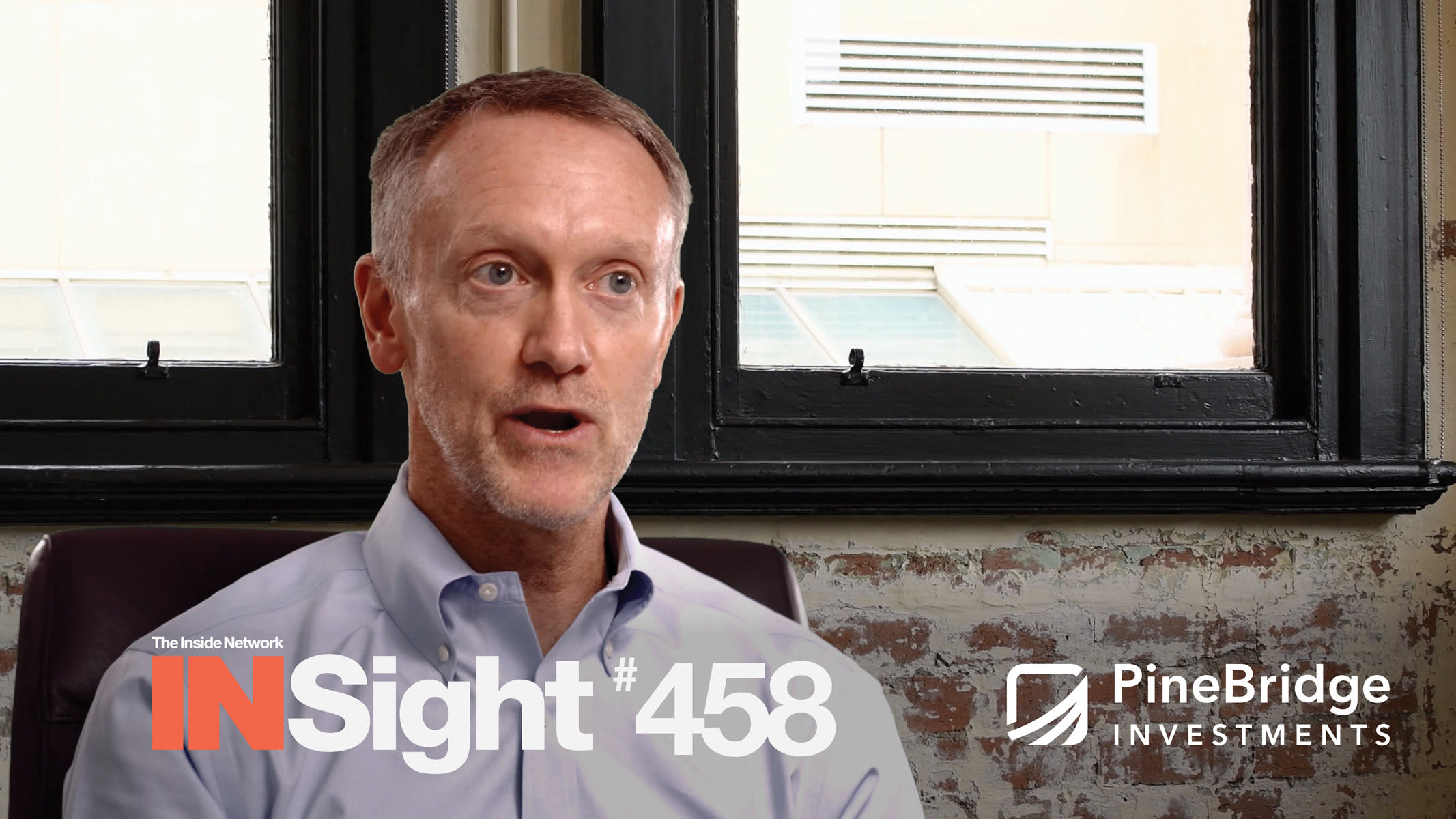
Rob Hinchliffe from PineBridge Investments speaks to James Dunn from The Inside Network on the points of differentiation.
Blog
-

Daily Market Update: 24 October 2025
ASX overcomes tech selloff, energy, Karoon Gas (ASX:KAR) jump on Russia sanctions, Comm Bank (ASX:CBA) reversal continues
The local market managed to eke out a positive day of trading after falling strongly early, following a weak night for the US market. The technology sector was dragged lower by valuation concerns, falling 0.9 per cent, with the likes of WiseTech (ASX:WTC) and Zip Co (ASX:ZIP) also caught up in the sell off. It was all about energy, however, as Woodside (ASX:WDS) gained 4.3 per cent and Karoon (ASX:KAR) 9.4 per cent after the US placed sanctions on two major Russian oil producers which sent the price of oil surging. The banking sector continues to weaken, led by the Commonwealth Bank (ASX:CBA) which fell 1.4 per cent, as investors move to a more risk off mode. The sell off in gold wasnt fully felt by the gold miners as both Northen Star (ASX:NST) and Regis (ASX:RRL) managed to post more than 2 per cent gains after the former delivered solid gold sales for the quarter.
Insurance Australia Group (ASX:IAG) buoyed by acquisition, Super Retail (ASX:SRL) sinks on sales weakness, Ainsworth (ASX:AGI) under offer
Insurance Australia Group (ASX:IAG) managed a solid gain, as the insurer upgraded profit guidance folliowing completion of its RACQ Insurance business acqisition, with it now expecting to see premium growth increase, likely through price increased, by around 10 per cent, an improvement on prior estimates. Shares in pokies maker Ainsworth Game Technology (ASX:AGI) posted a 4 per cent gain, after the company confirmed a maor share holder had bid for a part of the business. Super Retail Group (ASX:ASX:SRL) owner of the likes of Macpac and BCF fell sharply, down 4 per cent, after the company flagged like for like sales growth of just 2.6 per cent amid a tough spending environment for the sector. BHP (ASX:BHP) also improved after management confirmed they were in commercial conversations with the Chinese government and the Chairman flagged the potential for aggressive moves in the coming years.
US markets rally on US-China meet, oil strength continues, International Business Machines (NYSE:IBM) flat despite solid result
All three US benchmarks posted solid gains as President Trump confirmed a meeting with Chinese leads Xi next week amid hopes that the trade war will be settled, the Dow Jones gained 0.3, the S&p500 0.6 and the Nasdaq 1 per cent. It was widespread strength, with further sanctions on Russian exports pushing the price of oil higher, as the President seeks leverage. Tesla (NYSE:TSLA) reversed yesterdays losses, gaining more than 2 per cent after reporting solid profit growth as buyers flocked to EVs ahead of the end of government tax credits in the US, the focus remains on the RoboTaxi business. International Business Machines (NYSE:IBM) was broadly flat after reporting revenue growth of 14 per cent in two key software divisions, in particular the Red Hat technology division. Nokia Oyj reported much stronger than anticipated results as the company continues to pivot into AI and cloud services, in a significan turnaround for the mobile phone business.
Australian Indices Daily % Weekly % 1 Month % 3 Month % 1 Year % ASX 200 0.0 -0.4 2.1 4.5 13.6 Financials -0.5 0.6 2.4 6.9 19.2 Resources 0.7 -2.5 5.8 12.0 16.0 Information Technology -0.2 -0.6 -4.5 -2.5 20.6 Global Indices Daily % Weekly % 1 Month % 3 Month % 1 Year % US 500 0.6 1.3 2.5 7.1 19.1 Europe -0.3 -0.3 3.5 3.4 23.1 Japan -1.1 1.4 3.8 9.8 28.4 China top 50 0.5 -0.4 0.9 3.6 31.6 India top 50 0.2 0.9 5.0 1.4 2.4 Fixed Interest Daily % Weekly % 1 Month % 3 Month % 1 Year % Australian Treasury Bond -0.1 0.2 1.0 1.7 6.4 Australian Corporate Bond 0.0 0.2 0.9 1.8 7.0 US Treasury 0.0 0.5 1.3 3.2 5.2 Cash 0.1 0.3 1.0 4.2 Commodities & Crypto Daily % Weekly % 1 Month % 3 Month % 1 Year % Gold -0.8 -4.3 9.4 20.8 51.6 Silver -0.5 -9.8 9.6 23.1 42.3 Crude Oil 3.7 2.7 -6.9 -7.5 -5.1 Bitcoin -0.4 -1.1 -1.5 -6.4 63.9 -

For absolute returns, look for love of craft
The hedge fund universe has long been a misunderstood corner of the investment landscape, particularly among Australian private wealth investors. But Tim Cheung, chief executive of Mantis Funds, believes that alternatives, and hedge funds in particular, are entering a new era of relevance, one defined by precision, purpose and, above all, alignment.
“For us, absolute returns really means absolutely positive returns,” Cheung says. “A lot of investors have cash-plus or CPI-plus objectives, and they’re asking how to access that. On the liquid alternative side, you’re talking about pure alpha. Skill that is uncorrelated and repeatable. That’s what we’re trying to isolate.”
This focus on alpha and manager quality is central to Cheung’s approach. In a market flooded with strategies claiming to be ‘alternative’, his team filters potential investments through a rigorous, multi-layered lens, beginning with the most fundamental of questions: is the strategy legitimate?
“When you’re investing in something new, especially in alternatives, threshold question number one is: is it a fraud?” he says. “It sounds extreme, but in our experience, around three out of every hundred managers on which we do diligence don’t pass that bar. Less-than-salubrious characters do find their way into the system.”
Beyond legitimacy, Cheung looks for what he calls “genuine love of the craft.”.Investing is hard, he notes, and success requires more than intelligence, it requires intrinsic motivation. “My former boss at a large hedge fund in New York once shut down the fund, and the press release read: ‘Investing is hard.’ We got mocked for it, but it’s true,” he recalls. “We want managers who love what they do.”
Yet the most difficult challenge, especially in the Australian context, is alignment. “The industry talks about alignment all the time,” Cheung says. “But true alignment, superhuman alignment, is rare. We’re talking about the structures that govern fees, carry, co-investment, and ultimately, who gets paid what and when.”
The misalignment is especially stark when viewed through a local lens. “We’ve got investors who want to pay 4 per cent of returns as a fee, so if the manager makes 20 per cent, they want to pay 80 basis points. Meanwhile, tier-one investors in the best global hedge funds are paying 50 per cent. “That’s five-zero. The manager makes $20, and the client pays $10,” he says. “That level of alignment is not something many Australian wealth clients are used to, or willing to stomach.”
Still, Cheung insists that hedge funds have a legitimate role to play in core portfolio construction, if they can be accessed in the right format. “There is a hedge fund strategy that should be part of everything we do for our clients,” he says. “But packaging and delivery matter. Liquidity, transparency, even language, all play a role in bridging the gap.”
He acknowledges the psychological scars still lingering from the global financial crisis. “We constantly hear from investors who say, ‘I tried that before the GFC, it ‘gated,’ I’m never touching it again,’” Cheung says. “And to those people, I say: let’s approach this like forensic analysts. Let’s look at what others are doing today, tier-one institutions, endowments, pensions, and let’s ask: what are we missing?”
That forensic approach is key to rebuilding trust. Rather than rely on old assumptions, Cheung urges advisers to re-examine the strategies through a contemporary lens. “The role of people like us is to bridge that informational and emotional gap,” he says. “We’re not here to push product. We’re here to help advisers understand what these strategies are and are not.”
Education, in his view, is still the greatest hurdle. “Even when an adviser understands the strategy, the next question is: how do I explain this to my client?” Cheung says. “That’s where we have to step in, with communication tools, with portfolio context, and with structures that are actually usable.”
Ultimately, Cheung’s message is one of cautious optimism. Alternatives, and hedge funds in particular, may never be universally loved in the retail market, but they don’t have to be. “If we can bring institutional-grade strategies into the wealth space with the right alignment, structure and support, that’s a game-changer,” he says. “It’s not about everyone buying-in: it’s about the right investors getting access to the right solutions.”
-

Liquid alternatives: Navigating the five structural forces reshaping portfolios
“There are five structural forces reshaping how we need to think about markets: deglobalisation, defence, decarbonisation, dollar displacement and demographics.” This is the core thesis of Razvan Remsing, director of investment solutions at Aspect Capital, on the case for liquid alternatives amid rising macro complexity.
Remsing outlined a world shaped not by cyclical fluctuations, but by structural transformations. “We’ve got some macro drivers that are enduring,” he said, “and they are pointing to lasting change across the global landscape.”
The first of those drivers is deglobalisation. “We’re thinking about tariffs and reshoring,” he said. “The pandemic and recent years have exposed the fragility of supply chains. People would rather pay more for a more secure supply that’s closer to home or at least in a friendly economy.”
Alongside that sits a second force: defence. “We’ve got an administration in the US that’s been elected to break up the system,” Remsing observed. “It’s raised questions around NATO and international commitments. Russia’s aggression continues in Europe. And all of this requires more spending.” The implication, he said, is clear. “It feels inflationary, uncosted, and a sea change from the last few friendly decades in geopolitics.”
The third structural force is decarbonisation. “It’s the challenge of our generation,” he said. “We need to electrify and introduce reliable energy sources. But at the same time, we’ve got this AI wave, which needs a lot of electricity to power up. That dual demand is pretty constructive for commodity markets.”
Another theme is the potential displacement of the dollar. “The US has been attacking its allies and throwing the rule book out the window,” Remsing said. “During the tariff tantrums, the flight to safety wasn’t the US dollar. It was the euro, the Swiss franc and the yen. And gold continues to be well supported in this environment.”
The final structural force is demographics. “It should be fairly obvious to us in the financial planning and wealth industry that the world is changing rapidly,” he said. “The average client in ten years will be older. Fertility rates are shifting. And that changes what portfolios will need to deliver.”
Together, these five forces form what Remsing sees as a new macro regime. “These structural changes are not things that can easily turn around,” he said. “They are expensive, they are uncosted, and they are inflationary. It’s going to be an unstable environment for some time.”
In this context, he argued for an approach that prioritises liquidity, adaptability and breadth. “We’ve been doing this for a long time at the firm. We trade 200 assets globally,” he said. “It’s not about fitting a model to every quarter. It’s about building a strategy that’s able to navigate a wide range of macro regimes.”
He was explicit about the need for strategies that respond to stress. “This is not just about crisis alpha when equity markets fall,” he said. “We’ve navigated stagflation in the 1970s, the Asian crises of the 1990s, the tech wreck, the GFC. What matters is the ability to adapt, to remain resilient and to deliver in liquid terms.”
Remsing also addressed correlations. “Any alternative manager should be lowly correlated. That’s the starting point,” he said. “We have nearly three decades of live data showing negligible correlation to equities, bonds and other investment strategies. And we do this while operating inside those same asset classes.”
Importantly, the strategy is not built on prediction. “Every time we have a period of crisis or dislocation, it’s different,” he said. “The only consistent thing is that if you don’t have a diversifier that can navigate that, and you get a call on liquidity at the wrong time, your portfolio suffers.”
When new analysts join the firm, he gives them a task. “I ask them to find a pattern in the annual return streams across asset classes,” he said. “And then I let them out of their misery. There is no pattern. There’s no one asset that always wins. The macro backdrop is different every time.”
This, he said, is why liquid alternatives are a necessary part of long-term portfolio design. “We all have equity beta in our portfolios. That’s where we get the growth from. But in moments of stress, it behaves in very specific ways. You need something else in there that can act when it matters.”
“The embers of inflation have not been extinguished,” he argued. “And when stocks and bonds no longer give you the diversification you thought you had, having something that is adaptive, agile, resilient, diversifying and liquid is no longer optional. It’s essential.”
-

Defensive credit in practice: delivering income with control
As Australia’s lending landscape continues to evolve, non-bank real estate credit has become an increasingly important component of a diversified portfolio. Within Barwon Investment Partners’ First Mortgage Fund, two key loan types, residual stock loans and bridge financing for value-add commercial properties, are contributing to the fund’s ability to generate attractive returns while maintaining a measured risk profile.
Residual stock loans: Liquidity and stability
‘Residual stock’ lending provides financing against completed but unsold residential units or land lots. Unlike construction finance, these loans are secured by finished, saleable assets, removing exposure to build-phase risks.
Because each unit or lot can be sold individually, these loans have a natural liquidity advantage. As sales settle, the loan balance progressively reduces, with each transaction typically occurring at a value greater than the debt secured against it. The result is a steadily declining loan-to-value ratio and an improving liquidity profile, both of which enhance investor protection.
This segment is further supported by structural tailwinds in Australia’s housing market. Chronic undersupply and consistent demand have kept vacancy rates low and rents rising, ensuring that completed stock continues to find ready buyers. While yields are typically lower than for construction loans, the risk-adjusted returns remain highly attractive. For these reasons, residual stock loans have become a growing area of focus within Barwon’s first mortgage strategy.
Bridge financing: Controlled exposure with defined exits
‘Bridge’ loans on income-producing commercial properties undergoing light refurbishment or lease-up also represent an appealing niche. These short-term, interest-only facilities, generally 6 to twenty-four months in duration, allow property owners to implement value-add initiatives such as renovating floors, upgrading amenities or re-leasing vacant space.
Importantly, these are operating assets that usually generate at least partial income during the term. That cash flow can offset a portion of the interest expense, supporting both the borrower’s servicing capacity and the fund’s distribution profile. The risk profile is correspondingly modest, with incremental improvements rather than speculative redevelopment.
Each facility is structured around a clear exit strategy. Once income reaches a stabilised level that meets bank criteria, borrowers typically refinance into cheaper, long-term debt, creating a predictable and near-term repayment horizon. With banks remaining selective toward traditional assets, non-bank lenders such as Barwon that are able to accurately underwrite, and price transitional risk, provide an effective source of capital in this segment while achieving attractive risk-adjusted returns.
Strategic positioning in a shifting market
Non-bank lenders now play a crucial stabilising role in Australia’s capital markets. As regulatory capital requirements continue to constrain major banks, alternative credit managers like Barwon are filling the funding gap for quality borrowers. This shift has created a structural opportunity: disciplined, asset-backed lenders can earn a premium for liquidity provision without assuming undue risk. The result is a more resilient ecosystem in which borrowers maintain access to funding, while investors benefit from the steady income and diversification traditionally associated with core real estate, but through a credit lens.
Both residual stock and bridge finance loans illustrate the broader evolution of non-bank real estate credit. They provide borrowers with the flexibility to complete sales or reposition assets in an orderly manner, while offering investors exposure to defensive, income-generating collateral with clearly defined exit pathways.
Current market dynamics further reinforce their appeal. Australia’s housing shortage and constrained construction pipeline underpin residual stock values, while conservative bank lending standards continue to create opportunity in commercial bridge lending.
For Barwon, these segments form an integral part of the First Mortgage Fund’s ongoing strategy. By combining prudent loan structures, disciplined underwriting and exposure to real, income-producing assets, the fund continues to deliver on its objective: consistent income and capital stability for wholesale investors in a changing credit environment.
Jonathon Pullin is a partner at Barwon Investment Partners and head of real estate credit
-

Advice’s next generation set to be celebrated
There is often plenty of gloom expressed in the advice industry about declining numbers and the difficulty in persuading bright and committed people into the industry, but sometimes the industry can lose sight of what it actually has in the form of a wave of outstanding young practitioners building rewarding careers.
That is the contention behind The Inside Network’s decision to launch Australia’s first-ever 40 Under 40 Awards, a landmark initiative recognising the next generation of financial advisers and professionals driving innovation, professionalism and growth across the advice sector.
Dedicated to supporting and uplifting Australia’s vibrant community of advisers, advice practices and licensees, The Inside Network’s new awards will shine a spotlight on outstanding individuals shaping the future of wealth management, from rising stars to emerging leaders.
Open for nominations across 10 diverse sub-categories, the awards will celebrate excellence in areas including financial advice, investment, research, responsible investing, technology, community engagement and client experience. Together, they capture the creativity, ambition and integrity defining the next generation of advice professionals.
Nominations are now open and will close on 7 November 2025, with the shortlist announced on 17 November. Winners will be unveiled at a Melbourne awards ceremony on 26 November 2025.
The INFIN: Future Financial Leaders 40 Under 40 Awards selection committee comprises of senior leaders from advice firms, licensees, and industry associations, ensuring a transparent, independent and merit-based judging process.
“The advice industry continues to evolve rapidly, and it’s never been more important to recognise the people driving that change,” says Charlie Viola, executive chair, adviser and founding partner at Viola Private Wealth. “The 40 Under 40 Awards will celebrate those who are not only excelling in their careers but are also contributing to the long-term sustainability and reputation of our profession.”
Steve Sloane, adviser and founder of Link Wealth Group, added: “We have so many talented young professionals across the advice landscape who are innovating, connecting with clients in new ways and setting the tone for what great advice looks like in the future. These awards are about celebrating that energy and vision.”
The 40 Under 40 Awards are set to become an annual benchmark for excellence in the Australian advice community, spotlighting those who exemplify leadership, innovation and commitment to helping Australians achieve their financial goals.
Read more about the awards here
-

Best career advice: IN60 with Zac Midalia from Alceon Group
Zac Midalia from Alceon Group speaks to Laurence Parker-Brown from The Inside Network for our IN60 series.
-

Daily Market Update: 23 October 2025
ASX falls 0.7 per cent as gold miners sink, Newmont (ASX:NEM) dumped, energy rallies on Woodside (ASX:WDS) result
The All Ordinaries (ASX:XAO) fell from all-time highs on Wednesday, as a heavy selloff in gold dragged the materials sector more than 3 per cent lower. Energy was the only true standout, with the sector gaining more than 1 per cent on signs that US stockpiles were falling and following a solid result from Woodside (ASX:WDS). Both Regis Resources (ASX:RLL) and Newmont (ASX:NEM) fell by between 8 and 10 per cent following a 6 per cent fall in the price of gold overnight, with commentators suggesting the long-term outlook for gold remained positive despite hitting all-time highs. The Big Four Banks including Commonwealth Bank (ASX:CBA) all posted solid days, averting a heavy sell off in the ASX. Oil and gas producer Woodside (ASX:WDS) was a standout, with the company adding more than 3 per cent after positing a jump in quarterly production to 50.8 million barrels and increasing guidance for the rest of the year.
Pinnacle (ASX:PNI) rallies on Japanese deal, Adairs (ASX:ADH), Cettire boosted by stronger sales
Funds management distributor Pinnacle (ASX:PNI) gained more than 2 per cent after the company announced plans to acquire a significant stake in Advantage Partners, a large Japanese private market investment firm, amid growing interest in private equity and credit. Luxury retailer Cettire (ASX:CTT) showed signs of stabilisation, after the company delivered an 18 per cent jump in non-US revenue, which was enough to overcome total sales that fell 3 per cent to $150 million. Homewares retailer Adairs (ASX:ADH) surged strongly as the company flagged lower sales for the quarter, but well ahead of expectations, as the retail sector begins to settle. It was a similar story for toll road operator Atlas Arteria (ASX:ALX) which held ground on a tough day after converting 1.2 per cent traffic increases into 10.9 per cent increases in toll revenue around the world.
Nasdaq, gold miners sink amid trade standoff, Netflix (NYSE:NFLX) weaker on inline results, Texas Instruments (NYSE:TXN) flags slowing growth
Gold continued to sell off which doesn’t bode well for Australian miners today, with another 3 per cent fall in the precious metal as momentum begins to turn against the popular investment. But it was all about earnings season and big tech with the Dow Jones falling 0.7 per cent, S&P500 0.5 per cent and the Nasdaq down 0.9 per cent. Shares in Netflix (NYSE:NFLX) slumped by more than 10 per cent after the company reported net income of just $3.24 billion on revenue growth 17 per cent,, flagging concerns of slowing growth for the business, which was also impacted by a tax dispute with the Brazilian Government going back several years. Analog chip producer Texas Instruments (NYSE:TXN) dropped by more than 5 per cent after reporting weaker sales growth as industrial firms pause purchases and their expansion amid uncertainty. Telecoms group AT&T (NYSE:T) outperformed, falling close to 2 per cent after the company delivered weaker sales amid a highly competitive mobile phone market in the US.
Australian Indices Daily % Weekly % 1 Month % 3 Month % 1 Year % ASX 200 -0.7 0.4 2.5 5.2 13.5 Financials -0.1 1.7 2.8 7.6 19.8 Resources -2.6 0.5 9.5 16.1 18.3 Information Technology 0.0 -1.1 -4.4 -1.6 19.0 Global Indices Daily % Weekly % 1 Month % 3 Month % 1 Year % US 500 -0.5 1.3 2.2 7.9 20.0 Europe -0.4 1.3 3.4 5.2 23.9 Japan -0.1 2.4 3.0 13.9 29.0 China top 50 -2.1 1.0 0.6 6.1 30.7 India top 50 0.1 2.3 4.2 1.4 2.3 Fixed Interest Daily % Weekly % 1 Month % 3 Month % 1 Year % Australian Treasury Bond 0.0 0.6 1.1 1.8 6.5 Australian Corporate Bond 0.1 0.6 1.0 1.9 7.2 US Treasury 0.1 0.4 1.3 3.2 4.4 Cash 0.0 0.1 0.3 1.0 4.2 Commodities & Crypto Daily % Weekly % 1 Month % 3 Month % 1 Year % Gold -0.3 -0.5 13.8 23.2 55.1 Silver -0.4 -4.7 15.9 29.5 47.2 Crude Oil 2.4 -1.0 -7.2 -9.5 -7.9 Bitcoin 0.8 -1.6 -2.2 -7.9 66.8 -

Misconceptions about private credit: IN60 with Lauren Ryan from Thinktank
Lauren Ryan from Thinktank speaks to Laurence Parker-Brown from The Inside Network for our IN60 series.
-

INSight #457 with Rob Hinchliffe from PineBridge Investments
Rob Hinchliffe from PineBridge Investments speaks to James Dunn from The Inside Network on the history of outperformance.