Blog

  • Daily Market Update: 12 November 2025

    Daily Market Update: 12 November 2025

    Commbank says ‘no, we can’t’

    A slump in Commonwealth Bank of Australia (ASX: CBA) weighed on the Australian sharemarket’s benchmark index on Tuesday, amid concerns about the lender’s net interest margin and higher costs. Commonwealth Bank of Australia (ASX: CBA) represents more than 10 per cent of the S&P/ASX 200 Index (ASX: XJO), so a fall of $11.52, or 6.6 per cent, in the banking giant was always going to put the index under pressure.

    The S&P/ASX 200 Index (ASX: XJO) retreated 17.1 points on the day, or 0.2 per cent, to 8,818.8 points, with nine out of the 11 sectors closing higher.

    Commonwealth Bank of Australia (ASX: CBA) closed at $163.40 after reporting a $2.6 billion cash profit in the September quarter (the first quarter of its financial year). And while operating income was up 3 per cent, operating expenses increased 4 per cent on the back of higher wages and IT costs. The headline net interest margin was reduced, but the bank did not quantify the fall.

    Among the other major banks, National Australia Bank Limited (ASX: NAB) slid 57 cents, or 1.3 per cent, to $42.70; Australia and New Zealand Banking Group Limited (ASX: ANZ) added 18 cents, or 0.5 per cent, to $38.16; and Westpac Banking Corporation (ASX: WBC) firmed 53 cents, or 1.3 per cent, to $40.05. Smaller lender Bendigo and Adelaide Bank Limited (ASX: BEN) sank $1.08, or 8.5 per cent, to $11.64 after reporting a 3.2 per cent slide in cash earnings in the September quarter.

    In the big materials stocks, BHP Group Limited (ASX: BHP) strengthened 14 cents, or 0.3 per cent, to $42.79; Rio Tinto Limited (ASX: RIO) retreated 23 cents, or 0.2 per cent, to $129.56; and Fortescue Ltd (ASX: FMG) eased 3 cents, or 0.2 per cent, to $19.90. Energy heavyweight Woodside Energy Group Ltd (ASX: WDS) gained 41 cents, or 1.6 per cent, to $26.55, while Santos Limited (ASX: STO) rose 16 cents, or 2.5 per cent, to $6.58.


    Lithium lights up resources screens

    Lithium stocks were higher as the price of spodumene (the type of hard-rock lithium that is mostly mined in Australia) rose a further 6.2 per cent on Monday to $US1,011 a tonne, the highest level since June 2024. The spodumene price has almost doubled over the past five months.

    In response, producer Pilbara Minerals Limited (ASX: PLS) was up 24 cents, or 7.5 per cent, to $3.44; Liontown Resources Limited (ASX: LTR) jumped 9 cents, or 7.8 per cent, to $1.24; Mineral Resources Limited (ASX: MIN), which mines iron ore and lithium, appreciated $2.64, or 6 per cent, to $46.92; and IGO Limited (ASX: IGO), which mines lithium and nickel, was up 29 cents, or 5.4 per cent, to $5.63.

    In coal, Whitehaven Coal Limited (ASX: WHC) slipped 15 cents, or 2 per cent, to $7.17; and Coronado Global Resources Inc. (ASX: CRN) tanked 10.5 cents, or 28.4 per cent, to 26.5 cents, after it issued a warning that it could breach its debt covenant obligations, which could put its very existence at risk. Coronado Global Resources Inc. (ASX: CRN) reported a revenue fall and a loss for the recent nine-month period. But fellow coalminer Stanmore Resources Limited (ASX: SMR) put on 4 cents, or 1.8 per cent, to $2.29.

    In gold, Northern Star Resources Limited (ASX: NST) gained 80 cents, or 3.2 per cent, to $25.99; Evolution Mining Limited (ASX: EVN) put on 19 cents, or 1.7 per cent, to $11.27; Newmont Corporation (NYSE: NEM)lifted $5.67, or 4.3 per cent, to $136.52; Genesis Minerals Limited (ASX: GMD) gained 17 cents, or 2.8 per cent, to $6.20; and Capricorn Metals Ltd (ASX: CMM) rose 55 cents, or 4 per cent, to $14.24 as it released a conceptual study highlighting potential for underground mining beneath the Orion South open pit at its Mt Gibson Gold Project.


    Light & Wonder spreads both for shareholders

    Gambling products maker Light & Wonder Inc. (NASDAQ: LNW) surged $13.75, or 11 per cent, to $138.82, as investors continued to bask in an upbeat third-quarter earnings report, an expansion of its share buyback, and the plan to transition to a primary ASX listing. Elsewhere on the industrial screens, biotech heavyweight CSL Limited (ASX: CSL) pulled back a further 79 cents, or 0.4 per cent, to $178.12.

    The tech heavyweights were also under pressure, with logistics software leader WiseTech Global Limited (ASX: WTC) losing 19 cents, or 0.3 per cent, to $70.06; and family tracking app Life360 Inc. (ASX: 360) sliding $2.52, or 5.2 per cent, to $45.80 after unveiling a $US120 million deal to buy advertising technology company Nativo Inc. (Private).


    Dow Jones claims new record high

    In the US, the blue-chip Dow Jones Industrial Average (INDEXDJX: .DJI) pushed to a new record close, gaining 559.33 points, or 1.2 per cent, to close at 47,927.96, led by healthcare bigwigs Merck & Co., Inc. (NYSE: MRK), Amgen Inc. (NASDAQ: AMGN) and Johnson & Johnson (NYSE: JNJ). The broad S&P 500 Index (INDEXSP: .INX) ascended 14.18 points, or 0.2 per cent, to 6,846.61; but the tech-heavy Nasdaq Composite Index (INDEXNASDAQ: .IXIC) eased 58.87 points, or 0.3 per cent, as investors rotated out of technology stocks into other parts of the market trading at lower valuations.

    The markets are finally putting the US government shutdown in the rearview mirror, with just two hurdles to go: a House vote tonight our time, and then the Presidential rubber stamp.

    Australian IndicesDaily %Weekly %1 Month %3 Month %1 Year %
    ASX 2000.20.3-1.41.010.2
    Financials-1.50.10.85.115.1
    Resources1.01.82.012.022.0
    Information Technology0.1-3.0-9.8-8.12.4
    Global IndicesDaily %Weekly %1 Month %3 Month %1 Year %
    US 5000.20.74.77.315.9
    Europe0.80.81.84.727.4
    Japan-0.2-0.53.36.624.3
    China top 500.22.61.08.736.8
    India top 500.2-0.11.61.71.6
    Fixed InterestDaily %Weekly %1 Month %3 Month %1 Year %
    Australian Treasury Bond0.0-0.10.00.15.5
    Australian Corporate Bond0.0-0.10.10.36.2
    US Treasury 0.00.10.41.84.5
    Cash0.00.10.30.94.2
    Commodities & CryptoDaily %Weekly %1 Month %3 Month %1 Year %
    Gold2.13.33.221.557.0
    Silver3.64.5-1.132.264.5
    Crude Oil-0.6-0.73.0-3.00.6
    Bitcoin-0.40.0-14.0-14.319.1
  • Daily Market Update: 11 November 2025

    Daily Market Update: 11 November 2025

    ASX strengthens on shutdown optimism and sector gains
    The Australian sharemarket rallied at the start of the week, buoyed by optimism that the US government shutdown may soon conclude. The S&P/ASX 200 Index (ASX: XJO) surged 66.2 points to close at 8835.90, marking its strongest daily performance in four weeks. Investor sentiment improved amid a broader global risk-on mood as the US Senate advanced a funding bill. Nine of the eleven ASX sectors ended higher, led by technology. Life360 Inc. (ASX: 360) rose 3.6 per cent to $48.32, WiseTech Global Limited (ASX: WTC) jumped 6.2 per cent to $70.25, and Codan Limited (ASX: CDA) added 1.4 per cent. Meanwhile, rising oil prices pushed Woodside Energy Group Ltd (ASX: WDS) up 1.2 per cent to $26.14.

    Gold and mining stocks benefit from Fed speculation
    Gold miners also gained ground as gold prices advanced on expectations of a possible interest rate cut from the US Federal Reserve. Evolution Mining Limited (ASX: EVN) and Perseus Mining Limited (ASX: PRU) both climbed 3.9 per cent, while Northern Star Resources Limited (ASX: NST) rose 3.5 per cent. In financials, Australia and New Zealand Banking Group Limited (ASX: ANZ) rallied 3.2 per cent to a record $37.98 despite posting weaker cash profits, while Westpac Banking Corporation (ASX: WBC) added 1.4 per cent. However, Commonwealth Bank of Australia (ASX: CBA) and National Australia Bank Limited (ASX: NAB) ended in negative territory. Among notable movers, Downer EDI Limited (ASX: DOW) hit a five-year high following a $750 million contract with Chevron Australia, while Monadelphous Group Limited (ASX: MND) soared 11 per cent on a strong trading update.

    Global equities rally as US shutdown relief lifts sentiment
    Global markets began the week positively, led by Wall Street gains after the US Senate advanced a funding measure to potentially end the 40-day government shutdown. The S&P 500 Index (NYSEARCA: SPY) rose 1.6 per cent, the Nasdaq Composite Index (NASDAQ: IXIC) gained 2.4 per cent, and the Dow Jones Industrial Average (INDEXDJX: DJI) added 415 points. AI-related technology stocks led the rally, with NVIDIA Corporation (NASDAQ: NVDA) up 5.8 per cent, Palantir Technologies Inc. (NYSE: PLTR) up 8.8 per cent, Advanced Micro Devices Inc. (NASDAQ: AMD) up 4.5 per cent, and Micron Technology Inc. (NASDAQ: MU) up 6.5 per cent. Commentary from Federal Reserve Governor Stephen Miran supporting a potential 50 basis point rate cut in December helped boost risk assets. However, the shutdown still poses a risk, as delayed economic data and pending House approval could impact market stability.

  • From wrangling toddlers in Boston to advising bespoke Perth wealth

    From wrangling toddlers in Boston to advising bespoke Perth wealth

    When Lauren Walker first contemplated a career path, her sights were set on law. It was a field that promised prestige, intellectual challenge and purpose. Yet, as she would soon discover, her true calling lay not in the courtroom but in the boardroom, guiding clients toward financial independence and security.

    Today, as an accomplished adviser with global full-service investment bank Canaccord Genuity, Walker is recognised as one of the next generation of wealth professionals redefining what modern financial advice looks like. Her journey from a curious student to a finalist in the Women in Wealth Awards is a story of self-discovery, mentorship and courage to carve her own niche in a rapidly evolving industry.

    “I was initially heading towards law,” Walker reflects. “But my dad, who’s a financial adviser, suggested I try a role in a planning firm first. He thought it would give me a feel for the business world.”

    What began as a detour soon became a destination. That early exposure to financial advice revealed a career that combined analytical thinking, people skills and real-life impact, all values that resonated deeply with Walker

    But before she dived into finance, she took a year off to see the world. She moved to Boston, where she spent her gap year working as a nanny for a family who lived, as she fondly notes, “on ‘Matt Damon Street’.” The experience would prove formative in unexpected ways.

    “That year really matured me,” Walker says. “Living overseas gave me perspective. I was surrounded by wealth and success, and it made me realise that I wanted to understand how people create and manage that kind of financial stability.”

    When she returned to Australia, she enrolled in university and took an entry-level position in financial services at Perth firm Lighthouse Capital. It was there that her professional journey began in earnest.

    Walker started as a client services associate, learning the operational side of financial advice, the processes, compliance and client care that underpin great service. Over the next eight years, she climbed the ranks, supported by a strong commitment to education and professional standards.

    “I’ve always believed that technical knowledge builds confidence,” Walker explains. “I completed a Graduate Diploma, followed by a Master of Financial Advice, and became a qualified adviser at 26.”

    Her progression wasn’t simply about credentials. It was about mastering the language of advice, understanding not just products and portfolios, but people. “You can’t give meaningful advice without understanding what drives your clients,” she adds.

    Mentorship also played a central role in her growth. “I was lucky to have people who invested time in me, who taught me how to think strategically, manage relationships and navigate the regulatory landscape.”

    That experience has shaped her own leadership philosophy today. Walker is a strong advocate for mentoring young advisers and often participates in industry initiatives and university sessions to encourage others into the profession. “We need more visibility of successful, approachable role models in advice,” she says. “Especially for young women, who are still under-represented in the industry.”

    After eight years at Lighthouse Capital, Walker moved across to Euroz Hartleys, where she had a four-year stint. In February 2022, Walker joined Canaccord Genuity, where she is a senior financial adviser.

    “It was a big transition,” she admits. “I’d spent years at my previous firm, where I’d done my studies and built my foundations. Moving to a new environment, especially one that also houses investment advisers and stockbrokers, challenged me to find my own voice as an adviser.”

    Walker didn’t come alone; she brought her team with her, ensuring continuity for her clients and a supportive professional environment. At Canaccord, she partners closely with investment specialists to deliver holistic, strategy-led advice.

    “My role focuses on strategic advice, superannuation, tax planning, estate structuring and and risk management, while our investment partners handle the execution of tailored portfolios,” Walker explains. “Together, we build bespoke solutions for high-net-worth clients, combining deep technical strategy with market insight.”

    Walker’s clients are typically high-net-worth individuals and families seeking comprehensive wealth strategies. Each portfolio is distinct, reflecting the client’s goals, life stage and risk profile.

    “We don’t take a cookie-cutter approach,” she says. “Every client’s situation is unique. Some are still accumulating wealth, others are preparing for succession or retirement. The key is aligning investments to purpose.”

    Her portfolios often blend Australian and global equities, fixed income and defensive assets, with careful attention to liquidity and diversification. “We use both listed and unlisted securities,” she adds, noting that her clients are increasingly exploring opportunities in private credit and alternative assets.

    Yet, she’s quick to emphasise that the conversation isn’t just about returns. “Financial advice isn’t only about investments, it’s about strategy. My background as a registered tax agent means I’m always thinking about structure, tax-efficiency and long-term outcomes.”

    What sets Walker apart is her ability to connect, to listen deeply and translate complex financial concepts into clear, actionable advice.

    “My clients come to me for guidance, but also for partnership,” she says. “They want someone who can help them see the big picture, not just what’s in their portfolio, but how their wealth supports their life goals.”

    Her approach is collaborative, often involving accountants, lawyers and family members in strategic discussions. “We’re really building a family office mindset, integrated, forward-thinking and personal.”

    Equally important to Walker is giving back to the profession. She mentors junior advisers and regularly speaks at universities (she is a guest lecturer at Curtin University) and high schools, hoping to inspire students to see financial advice as a rewarding career.

    “It’s such a fulfilling profession,” Walker says. “We have the privilege of helping people make life-changing decisions. I want more young people, especially women, to see the diversity of paths within advice.”

    Walker’s dedication was recently recognised when she was named a finalist in the Women in Wealth Awards, celebrating her leadership and impact in the industry. “It was a proud moment,” she says. “Not just for me, but for all the women in advice who are working hard to elevate the profession.”

    She believes the industry is evolving in exciting ways, becoming more professional, transparent and client-focused. Yet she also acknowledges the challenges. “The regulatory environment continues to shift, which can be daunting for new entrants. But it’s also creating opportunities for advisers who are ethical, well-educated and client-centric.”

    Looking ahead, Walker is optimistic. “There’s so much scope for innovation in advice, from technology integration to intergenerational wealth planning. I’m excited to see how we can continue raising the bar.”

    Behind the professional polish, Walker is also a mother, a role she describes as grounding and perspective-giving. “Family time keeps me balanced,” she says. “It reminds me why we do what we do. Financial planning isn’t just about wealth, it’s about creating choices and freedom for the people we love.”

    As she reflects on her journey, from a young woman exploring her options in Boston to a respected adviser shaping futures at Canaccord, Walker’s story stands as proof that passion and purpose can align beautifully in a career built on trust, integrity, and human connection.

    “I never imagined I’d end up in finance,” she smiles. “But now, I can’t imagine doing anything else.”

  • Evergreen and Ascalon: Purchase or pivot point?

    Evergreen and Ascalon: Purchase or pivot point? 

    Australia’s asset-consulting landscape is being redrawn in real time. The latest marker is Ascalon Capital’s purchase of Evergreen Consultants (it’s been publicly described as a “merger,” but it isn’t). Under the terms understood in industry circles, Ascalon has acquired Evergreen, with the latter’s founder Angela Ashton (pictured) said to be staying on for about two years. On paper, it’s a neat fit. In practice, it raises awkward questions about where asset consultants now sit – and whether “scale” solves more problems than it creates.

    Insiders from both firms frame the transaction as a meeting of minds rather than a takeover: aligned investment philosophies, client-first positioning, and an acceptance that the bar to compete has risen well beyond the “two people and a laptop” era. The strategy is familiar: combine Evergreen’s research culture, ESG credentials and proprietary tools (think the GreenVUE investment analytics platform and the ERIG fund grading framework) with Ascalon’s governance spine, resourcing and institutional backers. The combined entity is described as servicing about 40–45 clients with roughly $4 billion in funds under advice (FUA) – contributed roughly equally – and being capable of adding $1 billion–$1.5 billion annually in organic growth, while preserving a bespoke consulting DNA.

    It all sounds eminently sensible. Yet the deal lands at a moment when asset consulting is wrestling with an identity crisis.

    “Get bigger or get out” has become an industry refrain. Platforms demand ever-broader services – model governance, practice management, data integration, reporting – while fee pressure grinds margins. Scale promises continuity, bench depth and better systems. But it also risks homogenising advice, nudging consultants from true independence toward productised solutions and “implemented consulting” that can blur the line between adviser, selector and manufacturer.

    When consultants stress they’ll keep bespoke mandates alongside off-the-shelf models, it’s an acknowledgement of this tension. The practical question is whether custom work can remain the norm when operating models, KPIs and cost discipline inevitably reward repeatability. Bespoke is artisanal; scale prefers assembly lines.

    Ascalon’s institutional capital and governance processes are real advantages in a tightening regulatory climate. Still, capital is never neutral. The more consultants migrate toward multi-service platforms, the harder it becomes to maintain the perception (and sometimes the reality) of arm’s-length independence. Procurement panels, revenue concentration and systems entanglement can create subtle incentives that shape research coverage, implementation choices, and the “house view.”

    If larger institutions do rationalise consultant panels to a handful of preferred providers – as many expect – the market may gain consistency but lose plurality. Herd behaviour is efficient until it isn’t.

    The industry’s “barbell effect” is well-observed: at one end, corporatised operators with deep pockets; at the other, founder-led boutiques that survive on niche insight and personal reputation. The middle is being squeezed. Consolidation can protect clients from key-person risk and operational fragility. But it can also starve the ecosystem of contrarian research and small-firm experimentation – the messy places where new ideas often originate. If every consultant must look, feel and report like a mini-institution, who does the original thinking?

    ASIC/APRA attention on managed accounts and governance amplified by cautionary tales from elsewhere pushes consultants to build heavier control frameworks. Good. Yet the burden is not just cost; it can shift focus from pure research to process compliance. For firms building “business consulting” arms alongside investment capability, role clarity matters. The more a consultant is embedded in implementation, the more clients should interrogate conflict management, fee transparency and escalation protocols.

    The Evergreen–Ascalon narrative is attractive: better research depth, stronger governance, superior reporting, and still bespoke. Delivering all four at once is possible—but operationally demanding. Integrating data models, risk systems, manager research taxonomies and client reporting across two firms is non-trivial. Maintaining research tempo while unifying methodologies is harder still. Meanwhile, markets don’t pause for integration.

    The growth targets – $1 billion–$1.5 billion a year of organic FUA – are ambitious. They may be achievable, but only if the combined firm can prove that “scale with independence” is more than a pitch line: faster due-diligence cycles without shortcuts; coverage breadth that doesn’t dilute conviction; and client-specific portfolio design that doesn’t quietly collapse into house models for efficiency’s sake.

    What clients should watch

    • Decision trails and conflicts: Clear, written frameworks showing how product, platform and implementation recommendations are separated from commercial interests – then evidenced in actual decisions.
    • Bespoke in practice: Frequency of model deviations, custom constraints honoured, and the turnaround time for client-specific research.
    • Research depth vs. coverage creep: Additions to coverage universes should be matched by resourcing, not just absorbed by analysts.
    • Panel exposure: How concentrated are the firm’s revenues in a few platforms or institutions, and what happens if panels consolidate further?
    • People continuity: With founder-level leaders on transition clocks, is succession real, resourced and visible to clients?

    Where does this leave asset consultants?

    Perhaps right where they’ve always been – between the ideals of independence and the economics of distribution. The purchase of Evergreen by Ascalon is a credible bid to square that circle: a privately owned, well-resourced platform that says it can scale without losing its bespoke core. It might work. But it will require constant choices that favour client specificity over operational convenience, and research integrity over panel pragmatism.

    If asset consulting is to avoid becoming just another channel for pre-packaged portfolio manufacturing, firms will need to prove – transaction by transaction, mandate by mandate – that their advice remains genuinely situational, their governance more than compliance theatre and their growth more than aggregation.

    This deal could be a model for a sturdier, more capable consultant; or it could be a milestone on the road to a narrower, more uniform marketplace. The industry will choose which.

  • Private infrastructure: The outperformer in a noisy market

    Private infrastructure: The outperformer in a noisy market

    Stewart Upson, co-president of infrastructure at Brookfield, believes the case for infrastructure as an investment class has never been stronger. With over US$350 billion ($538 billion) in assets and a presence in more than 30 countries, Brookfield is one of the world’s largest infrastructure investors. But for Upson, the appeal of the asset class extends well beyond scale or performance metrics. Infrastructure, he says, offers something most portfolios lack: stability with a built-in capacity for growth.

    At the heart of Brookfield’s strategy is a simple proposition, Upson told The Inside Network’s Alternatives Symposium. Infrastructure assets are the backbone of the global economy. These are not optional services, Upson explains, but essential systems such as transportation, utilities and communications. They are the operating systems of the modern world, and economies cannot function without them.

    The critical nature of these assets gives rise to a unique set of characteristics. Upson points to long-term contracted revenues, regulatory protections, and a historical tendency toward lower volatility. “Because these businesses are essential, they tend to operate under regulatory regimes or long-term agreements that ensure consistency and transparency,” he says. This consistency produces attractive, stable cash yields over time.

    Another key feature of infrastructure is its capability as a natural hedge against inflation. Upson highlights how many infrastructure assets have built-in mechanisms that allow for rising cash flows in tandem with inflation and interest rates. “What we have seen over many cycles is that infrastructure performs well even when other asset classes are under pressure,” he says. “When inflation rises, infrastructure cash flows tend to rise too.”

    This capacity to weather market cycles has become more valuable in recent years. As traditional asset classes have shown higher volatility, infrastructure has proven resilient. In some of the worst quarters for equities, private infrastructure has delivered positive returns, supported by its contractual income and inflation-linked pricing models.

    But Upson is careful to note that infrastructure’s value proposition is no longer just defensive. The sector has entered what he calls a supercycle, driven by three major global trends: digitalisation, decarbonisation and deglobalisation. Each of these megatrends requires significant infrastructure investment, creating new opportunities for growth.

    Digitalisation alone has redefined the scope of infrastructure. A decade ago, data centres and telecom towers were fringe concerns. Today, they are central. “Now we’re seeing the next wave of infrastructure demands, particularly from artificial intelligence,” Upson says. AI requires enormous computing power, and that in turn requires more data centres and vastly more electricity.

    This surge in demand for digital infrastructure is converging with the energy transition. Efforts to replace high-emission sources with renewables are already creating investment opportunities in power generation, transmission and storage. “We are building infrastructure to meet these challenges, but we are also investing in the systems that will enable AI to scale,” Upson says. “These two trends are not competing, they are reinforcing one another.”

    He sees AI not as a separate theme, but as a catalyst that is accelerating the infrastructure cycle. Unlike previous technological booms, where the focus was on software and platforms, the AI boom is hardware intensive. It requires assets with physical presence and heavy capital investment. Brookfield’s view is that AI cannot deliver returns without the infrastructure to support it.

    This is where Upson sees differentiation. The firm’s strategy is to focus on what he describes as the “picks and shovels” of AI, rather than speculative applications. “We are not looking for the next Facebook or Google,” he says. “We are building the facilities they need to operate. Data centres with GPU capacity. Energy infrastructure to power them. These are real assets with long-term contracts and predictable returns.”

    He acknowledges the hype surrounding AI and warns of bubbles forming at the speculative end of the market. But infrastructure, by its nature, tends to avoid such volatility. The opportunities, he says, are rooted in real demand and sound economics. “We are not in the business of chasing shiny objects. We are deploying capital with discipline, targeting strong credit quality and inflation protection.”

    Brookfield’s owner-operator model plays a significant role here. Unlike many fund managers, the firm originated as a balance sheet investor. It continues to hold significant ownership stakes in its assets, often with operating control. “We are not just allocating capital, we are running these businesses,” Upson says. This operational expertise allows the firm to identify inefficiencies and drive value beyond what passive investors can achieve.

    Geographically, the portfolio is diversified but guided by opportunity rather than allocation targets. Upson notes that returns in the US have recently been higher than expected, leading to greater investment in that region. “We go where capital is scarce and risk-adjusted returns are strongest,” he says. This approach has resulted in a portfolio that mirrors global GDP but is flexible enough to adapt to changing dynamics.

    The Australian market has played a meaningful role in Brookfield’s recent investments. AusNet, the transmission network for Victoria, and Neoen, a major renewable developer, are two local examples. Both assets, Upson explains, combine essential service delivery with embedded growth. These are the kinds of investments that infrastructure is uniquely positioned to deliver: low volatility with long-term upside.

    Upson is unequivocal in his view. Infrastructure is no longer just for pension funds and insurance companies. It has matured into an asset class that can stand alongside equities and bonds in a diversified portfolio. It is defensive when markets are turbulent and opportunistic when conditions align. “It is a quiet outperformer,” he says. “And it is becoming more essential by the day.”

  • Core property rebounds: The new cycle and the rise of alternatives

    Core property rebounds: The new cycle and the rise of alternatives

    Standing before advisers at the INZ: Investment Leaders Forum in Queenstown, Barwon Investment Partners’ Tom Patrick struck a hopeful tone. The partner and head of healthcare property at the Sydney-based alternatives manager argued that we are at the start of the new property cycle; and accordingly, demand for core commercial property has returned.

    Years of volatility, triggered first by COVID-19 and then by macroeconomic shocks, had pushed investors away from equity real estate and into defensive private credit. But as interest rates peak and stabilise, Patrick said, the spread between real estate yields and base rates is once again becoming attractive. “The pendulum is swinging,” he said. “People will still allocate to real estate credit, but increasingly more to ‘core’-style real estate.”

    This perspective is backed by investor data. According to CBRE’s Investor Intentions Survey, preference for core property strategies across the APAC region has doubled from 2024 to 2025, overtaking opportunistic and distressed strategies, which dominated during the inflation spike. For Patrick, the trend is clear. “We’re seeing renewed confidence in core property,” he said.

    Transaction volumes support this thesis. After a two-year slump during which buyers and sellers were separated by a wide valuation gap, volumes have begun to climb again in 2025. “That narrowing of the buy-sell spread shows us that confidence is returning, and that assets are now being correctly priced,” Patrick explained.

    Timing, he said, is critical. Core property returns, unlike equity markets, tend to unfold gradually, providing a long entry runway. Distressed and opportunistic real estate plays, by contrast, are compressed and highly sensitive to market conditions. “Commercial property returns go up the stairs and down the elevator,” Patrick noted. “That’s why your entry point into core matters so much.”

    The big shift, however, is not just a reversion to core, it’s also about where in core property the capital is going. “Institutional investors globally, and increasingly here in Australia, are looking at alternative core sectors,” Patrick said. These include healthcare, data centres, life sciences, and build-to-rent housing. In the US, allocations to these segments have steadily risen over the last decade, and Asia-Pacific (APAC) investors are now following suit.

    Barwon Investment Partners manages $3.7 billion invested across healthcare property, real estate credit, listed private equity and specialist disability accommodation. Healthcare is Patrick’s focus: he and his team invest across a wide spectrum, from diagnostic imaging clinics and medical centres to private hospitals and cancer care facilities. In Australia, healthcare represents more than 11 per cent of GDP and is second only to mining in national expenditure. “It’s a non-discretionary sector with significant government funding,” Patrick said. “That creates a compelling case for long-term investment.”

    Patrick pointed to the performance of healthcare real estate over the last 15 years as evidence of its resilience. According to MSCI data, it has been the second-best performing core property segment in the Australian market. With long leases, high occupancy and low incentives, it offers inflation-linked income with relatively low volatility. “We think the vintage for this sector is very good,” he said.

    Importantly, healthcare is still under-invested. Patrick said that while the sector has matured significantly in Australia over the past decade, allocations remain low compared to markets like the US and UK. “This part of the market still has a long way to run,” he noted. “Access can be difficult, but that creates opportunity for early investors.”

    Alternative sectors also help investors diversify away from the traditional office, industrial and retail mix that tends to be highly correlated with broader economic cycles. “These alternative segments, like healthcare, are less tied to macroeconomic outcomes,” Patrick explained. “They offer a way to build a more balanced portfolio with exposure to structural tailwinds.”

    The data supports this. In 2025, APAC-based investors have doubled their allocations to alternative property strategies, with industrial and office allocations falling in tandem. Retail, after years of underperformance, is also seeing renewed interest, albeit from a low base.

    In his closing remarks, Patrick urged advisers to revisit their real estate exposures, not just in terms of structure, but also in terms of strategy and access. “When you start to think about core-style property again, we believe this vintage is going to be particularly strong,” he said. “Institutional capital is shifting back in that direction.”

    His message was both cautionary and optimistic. Cautionary in the sense that distressed and opportunistic strategies will become harder to execute as pricing rebounds; optimistic because core property, often overlooked during the rate-hike era, now offers a clear runway for long-term growth and stable income. For financial advisers, the takeaways are practical. Understand the cycle. Re-evaluate the balance between debt and equity real estate. And explore the alternatives within core that offer genuine diversification and access to long-term themes. As Patrick concluded, “We think we’re early in this next phase. And for investors who can move now, the runway looks promising.”

  • Leveraging Python automation to enhance reporting efficiency and client engagement

    Leveraging Python automation to enhance reporting efficiency and client engagement

    Despite significant advances in portfolio management platforms, many advice firms continue to rely on manual workflows for report preparation, often involving repeated data extraction, spreadsheet manipulation and formatting. The outcome is consistent across the industry: valuable professional time is diverted from analytical and relationship-oriented activities toward administrative tasks that could be automated.

    Emerging automation technologies now provide a viable and scalable alternative. Among these, Python – a versatile and open-source programming language widely adopted across investment management and research – offers advisers an efficient means of transforming data into structured, compliant and visually professional reports.

    By integrating Python’s analytical and visualisation capabilities, an advice practice can transition from static spreadsheet reporting to interactive, data-driven outputs. A practical example involves the automation of quarterly portfolio summaries.

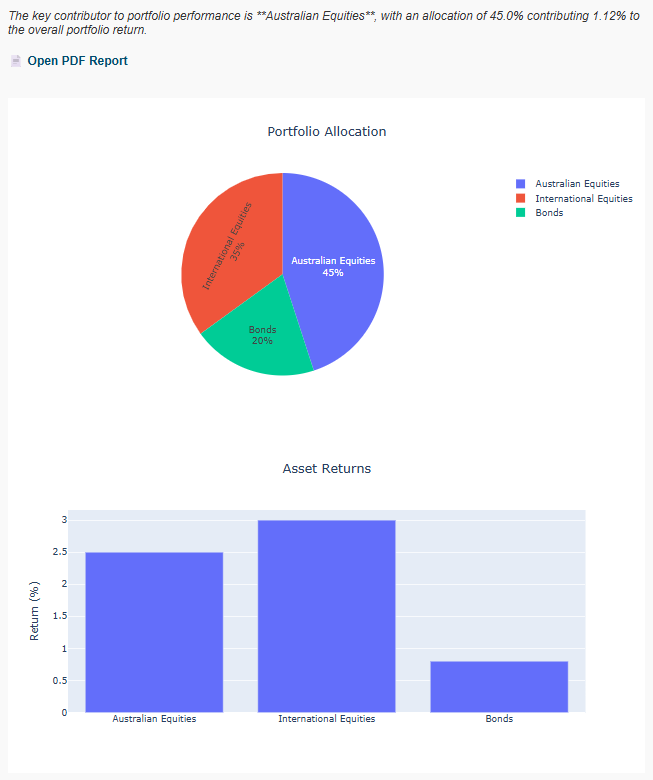
    To demonstrate what such an automation framework can achieve in practice, please visit the sample report generator below:

    https://auto-report-ccc6.onrender.com

    (Please note: the application may take approximately 30-60 seconds to initialise.)

    The illustrative interface enables the user to input up to three portfolio assets – including names, weights and returns – along with the client’s name. The system then processes these data points to generate a fully formatted PDF report within seconds.

    Upon submission, the system instantly performs the following processes:

    • Data calculation and aggregation: Python interprets the weightings and returns to calculate total portfolio performance, individual asset contributions and overall exposure metrics.
    • Analytical commentary generation: The system automatically identifies the asset that contributed most to portfolio performance, quantifies its weighting, and generates plain-language commentary (e.g., “International equities contributed 1.1 percentage points to overall performance, accounting for 35 per cent of the portfolio allocation.”).
    • Visualisation and reporting: Within seconds, Python creates a professional-quality pie chart of portfolio allocations, and a bar chart of asset class returns. These are compiled into a formatted PDF report, ready for review, archiving or client distribution.

    This demonstration represents only a simplified version of what is technically achievable. In practice, such a system can integrate with live portfolio management platforms, CRM databases or performance data feeds, enabling the automated generation of hundreds of client-specific reports simultaneously. Inputs could be drawn directly from custodial files, CSV or Excel data, or even APIs, removing the need for manual consolidation and cross-referencing.

    Beyond core performance reporting, Python’s modular structure allows the inclusion of additional analytical layers, including:

    • Risk metrics, such as volatility, drawdown and tracking error, which can be computed automatically and benchmarked across time periods or portfolios.
    • Stress testing and scenario analysis, enabling advisers to demonstrate portfolio resilience under various market or macroeconomic conditions (e.g., interest rate shocks, currency movements or equity drawdowns).
    • Compliance and mandate verification, ensuring asset allocations and exposures remain within agreed investment parameters.
    • Attribution analysis, breaking down performance by sector, asset class or currency effect to provide clients with a more complete understanding of portfolio behaviour.

    Each of these features can be configured to populate directly into pre-approved reporting templates, ensuring consistent visual identity, branding and disclosure language across all client materials. Importantly, because Python operates as an open-source and platform-independent framework, these solutions can be scaled or customised without reliance on proprietary software or ongoing licensing costs.

    Operational advantages

    Python’s integration potential with common data sources – including custodial platforms, CRM systems, and performance databases – means that data inputs can be standardised and refreshed automatically. The principal benefits to advice practices are threefold:

    • Efficiency and scale: Report production time is reduced from hours to minutes, enabling staff to redirect focus toward client engagement and strategic analysis. Automated templates ensure uniformity across a large client base without incremental administrative effort.
    • Accuracy and compliance: Automated workflows remove the risk of manual transcription or calculation errors, while maintaining version control and auditability – an increasingly important consideration under heightened regulatory expectations around client communication and record-keeping.
    • Enhanced client experience: Dynamic visualisations and concise commentary elevate the professional quality of reports, allowing advisers to communicate investment outcomes and portfolio positioning with greater clarity. Clients receive information that is timely, consistent and visually comprehensible.

    Beyond efficiency gains, the adoption of Python-based automation supports a broader strategic objective: positioning the practice as a data-enabled advisory business. This technological shift mirrors trends already established within institutional asset management, where Python underpins research, risk modelling and reporting infrastructure.

    For financial advisers, this means moving away from repetitive administrative workflows and toward higher-value activities such as portfolio construction, macroeconomic interpretation and behavioural coaching. In effect, automation does not replace professional judgement; it enhances the adviser’s capacity to apply it where it has the greatest impact.

    Automation within advice businesses is no longer an emerging concept but an operational necessity. Python provides a sophisticated yet accessible means to achieve this, combining analytical precision, visual presentation and workflow efficiency within a single framework.

    By adopting automated reporting systems, advisers can improve consistency, enhance compliance confidence, and allocate more time to delivering meaningful, client-centred advice – a competitive advantage in an increasingly data-driven industry.

    Ye Peng is a data scientist and developer at Atchison.

  • Daily Market Update: 10 November 2025

    Daily Market Update: 10 November 2025

    Australian market weakens for second week

    The S&P/ASX 200 Index (ASX: XJO) declined by 0.7 per cent on Friday to close at 8769.7, notching a second consecutive weekly loss as the market digested the Reserve Bank of Australia’s decision to hold the cash rate steady. Investor expectations for a rate cut this cycle have diminished. Financials dragged the index lower, led by Macquarie Group Limited (ASX: MQG), which dropped 5.7 per cent after its half-year profit missed estimates by over 10 per cent. Commonwealth Bank of Australia (ASX: CBA) also fell 1.5 per cent, though National Australia Bank Limited (ASX: NAB) recovered slightly, rising nearly 1 per cent.

    Technology and aviation sectors struggle

    Technology stocks mirrored weakness in the Nasdaq, with Iren Limited (ASX: IRE) plunging 12 per cent. Other tech names like WiseTech Global Limited (ASX: WTC)Life360 Inc (ASX: 360), and Xero Limited (ASX: XRO) posted losses. Mixed performances in materials saw Newmont Corporation (ASX: NEM) rise 1.8 per cent as gold neared US$4000 per ounce, while Rio Tinto Limited (ASX: RIO) and Fortescue Metals Group Limited (ASX: FMG) declined alongside falling iron ore prices. Alliance Aviation Services Limited (ASX: AQZ) plummeted 42.7 per cent as trading resumed post-suspension, revealing a weaker outlook and leadership change. Qantas Airways Limited (ASX: QAN) fell 6.6 per cent amid soft corporate travel demand, while Block Inc (ASX: SQ2) dropped 15.8 per cent following disappointing revenue. In contrast, News Corporation (ASX: NWS) rose 3 per cent on stronger-than-expected quarterly revenue.

    US consumer sentiment hits near-record low

    Globally, sentiment was shaken as the University of Michigan reported a sharp decline in its consumer sentiment index, falling to 50.3 in November, marking the second-lowest reading on record. This deterioration stemmed from growing concerns about a prolonged US government shutdown. The Current Economic Conditions Index dropped to an all-time low of 52.3, with a significant fall in personal financial assessments, while the Consumer Expectations Index dipped to 49.0. Inflation expectations were mixed, with short-term projections slightly rising and long-term expectations easing. Interestingly, confidence rose among households in the top third of stock ownership, buoyed by market performance.

    Australian IndicesDaily %Weekly %1 Month %3 Month %1 Year %
    ASX 200-0.7-1.2-2.00.59.1
    Financials-1.21.71.65.216.8
    Resources0.5-1.60.613.715.3
    Information Technology-1.7-4.5-10.3-10.73.5
    Global IndicesDaily %Weekly %1 Month %3 Month %1 Year %
    US 5000.1-0.62.06.715.5
    Europe0.60.74.025.3
    Japan-0.31.03.99.625.4
    China top 500.03.3-0.27.031.4
    India top 500.20.73.52.11.8
    Fixed InterestDaily %Weekly %1 Month %3 Month %1 Year %
    Australian Treasury Bond0.1-0.20.30.35.7
    Australian Corporate Bond0.1-0.20.30.46.4
    US Treasury 0.40.10.61.54.8
    Cash-0.2-0.20.00.73.9
    Commodities & CryptoDaily %Weekly %1 Month %3 Month %1 Year %
    Gold0.80.52.018.250.5
    Silver1.10.62.327.256.6
    Crude Oil0.2-2.5-2.9-4.0-3.8
    Bitcoin-1.4-7.5-16.5-13.233.6
  • INSight #452 with Tom Patrick from Barwon Investment Partners

    INSight #452 with Tom Patrick from Barwon Investment Partners

    Tom Patrick from Barwon Investment Partners shares insights with Larence Parker-Brown from The Inside Network on tailwinds in the healthcare real estate market.

  • Daily Market Update: 7 November 2025

    Daily Market Update: 7 November 2025

    Gold revival drives ASX rebound

    The Australian share market snapped its recent losing streak as investors piled back into the materials sector. The S&P/ASX 200 Index (ASX: XJO) rose 25.9 points, or 0.3 per cent, to close at 8827.9 on Thursday, marking a turnaround after losses in six of the previous seven sessions. Gold miners were among the standout performers, with Newmont Corporation (ASX: NEM) and Northern Star Resources Limited (ASX: NST) both rising 2.8 per cent, supported by bullion prices nearing US$3980 an ounce. The rally reflected stronger conviction among gold investors following recent volatility.

    Mixed day for banks and sectors

    Gains in the heavyweight mining sector offset weakness in financials, with major miners defying falling iron ore prices. BHP Group Limited (ASX: BHP) climbed 1.6 per cent, Rio Tinto Group (ASX: RIO) advanced 2.3 per cent, and Fortescue Metals Group Limited (ASX: FMG) added 2.1 per cent. However, the banking sector dragged, led by a 3.3 per cent fall in National Australia Bank Limited (ASX: NAB) after its full-year cash earnings of $7.09 billion missed expectations. Westpac Banking Corporation (ASX: WBC) slipped 1.2 per cent, while Commonwealth Bank of Australia (ASX: CBA)rose 1.3 per cent. Elsewhere, Light & Wonder Inc (ASX: LNW) jumped 8.2 per cent on a 78 per cent surge in quarterly net income, while James Hardie Industries plc (ASX: JHX) tumbled 12.7 per cent after being removed from the MSCI Australia Index.

    Wall Street falls on tech sell-off

    Global markets ended lower overnight, with renewed pressure on technology stocks dragging major US indices. The S&P 500 Index (NYSE: SPX) fell 1.1 per cent, the Nasdaq Composite Index (NASDAQ: IXIC) dropped 1.7 per cent, and the Dow Jones Industrial Average (NYSE: DJI) lost 317 points. AI-linked names were hit hard amid valuation concerns and mixed earnings, with Qualcomm Incorporated (NASDAQ: QCOM)Tesla Inc (NASDAQ: TSLA)Advanced Micro Devices Inc (NASDAQ: AMD)Oracle Corporation (NYSE: ORCL) and Palantir Technologies Inc (NYSE: PLTR) all declining. Mega-cap tech stocks such as NVIDIA Corporation (NASDAQ: NVDA)Microsoft Corporation (NASDAQ: MSFT)Amazon.com Inc (NASDAQ: AMZN) and Meta Platforms Inc (NASDAQ: META) also slid. Labour market jitters further weighed on sentiment, as Challenger reported 153,000 job cuts in October, the highest for that month in 22 years, mostly linked to AI restructuring and cost efficiency initiatives.

    Australian IndicesDaily %Weekly %1 Month %3 Month %1 Year %
    ASX 2000.3-0.5-1.61.010.8
    Financials0.21.51.24.617.7
    Resources1.4-2.9-0.912.114.2
    Information Technology-1.5-3.1-9.7-9.07.1
    Global IndicesDaily %Weekly %1 Month %3 Month %1 Year %
    US 500-1.10.52.77.318.3
    Europe0.7-0.30.14.824.6
    Japan1.5-0.4-0.17.422.6
    China top 501.4-1.3-2.35.027.9
    India top 50-0.10.43.82.13.0
    Fixed InterestDaily %Weekly %1 Month %3 Month %1 Year %
    Australian Treasury Bond-0.1-0.20.00.36.0
    Australian Corporate Bond0.1-0.20.10.46.6
    US Treasury -0.5-0.40.11.14.8
    Cash0.00.10.30.94.2
    Commodities & CryptoDaily %Weekly %1 Month %3 Month %1 Year %
    Gold0.10.22.317.551.0
    Silver0.7-0.4-0.225.856.7
    Crude Oil-1.1-1.6-2.5-4.5-6.1
    Bitcoin1.7-4.1-16.3-11.337.7