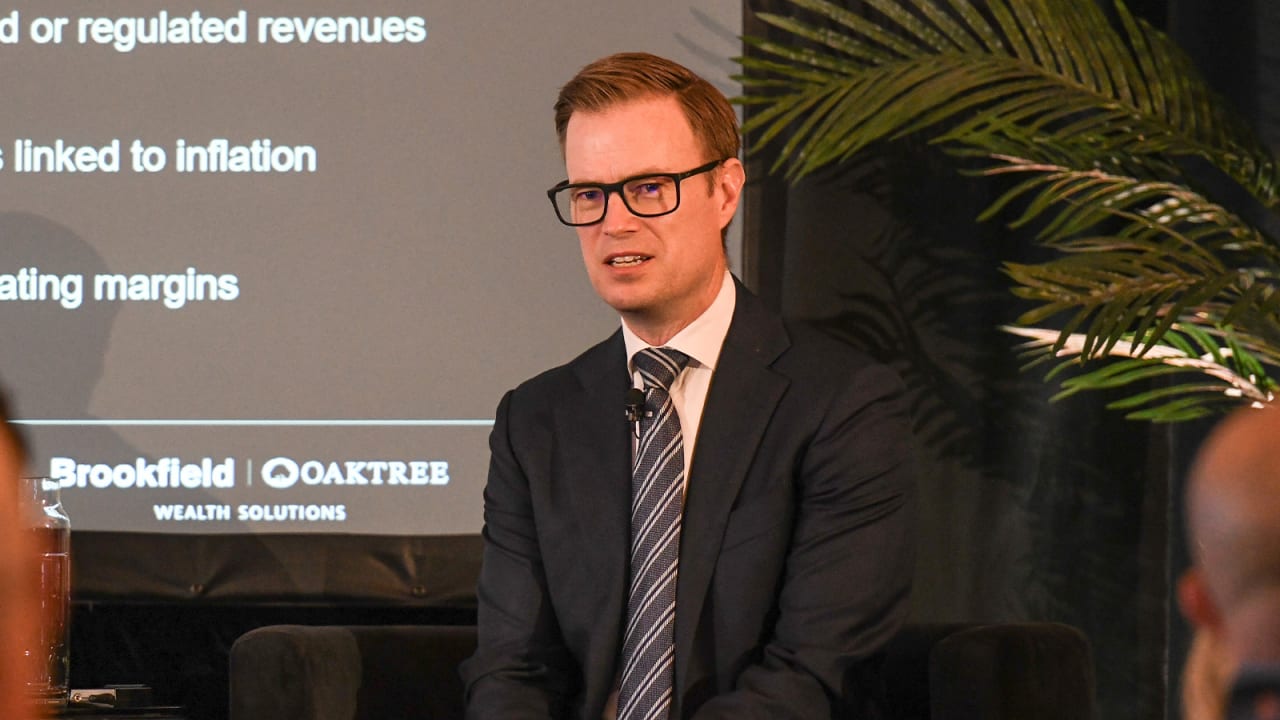
Stewart Upson, co-president of infrastructure at Brookfield, believes the case for infrastructure as an investment class has never been stronger. With over US$350 billion ($538 billion) in assets and a presence in more than 30 countries, Brookfield is one of the world’s largest infrastructure investors. But for Upson, the appeal of the asset class extends well beyond scale or performance metrics. Infrastructure, he says, offers something most portfolios lack: stability with a built-in capacity for growth.
At the heart of Brookfield’s strategy is a simple proposition, Upson told The Inside Network’s Alternatives Symposium. Infrastructure assets are the backbone of the global economy. These are not optional services, Upson explains, but essential systems such as transportation, utilities and communications. They are the operating systems of the modern world, and economies cannot function without them.
The critical nature of these assets gives rise to a unique set of characteristics. Upson points to long-term contracted revenues, regulatory protections, and a historical tendency toward lower volatility. “Because these businesses are essential, they tend to operate under regulatory regimes or long-term agreements that ensure consistency and transparency,” he says. This consistency produces attractive, stable cash yields over time.
Another key feature of infrastructure is its capability as a natural hedge against inflation. Upson highlights how many infrastructure assets have built-in mechanisms that allow for rising cash flows in tandem with inflation and interest rates. “What we have seen over many cycles is that infrastructure performs well even when other asset classes are under pressure,” he says. “When inflation rises, infrastructure cash flows tend to rise too.”
This capacity to weather market cycles has become more valuable in recent years. As traditional asset classes have shown higher volatility, infrastructure has proven resilient. In some of the worst quarters for equities, private infrastructure has delivered positive returns, supported by its contractual income and inflation-linked pricing models.
But Upson is careful to note that infrastructure’s value proposition is no longer just defensive. The sector has entered what he calls a supercycle, driven by three major global trends: digitalisation, decarbonisation and deglobalisation. Each of these megatrends requires significant infrastructure investment, creating new opportunities for growth.
Digitalisation alone has redefined the scope of infrastructure. A decade ago, data centres and telecom towers were fringe concerns. Today, they are central. “Now we’re seeing the next wave of infrastructure demands, particularly from artificial intelligence,” Upson says. AI requires enormous computing power, and that in turn requires more data centres and vastly more electricity.
This surge in demand for digital infrastructure is converging with the energy transition. Efforts to replace high-emission sources with renewables are already creating investment opportunities in power generation, transmission and storage. “We are building infrastructure to meet these challenges, but we are also investing in the systems that will enable AI to scale,” Upson says. “These two trends are not competing, they are reinforcing one another.”
He sees AI not as a separate theme, but as a catalyst that is accelerating the infrastructure cycle. Unlike previous technological booms, where the focus was on software and platforms, the AI boom is hardware intensive. It requires assets with physical presence and heavy capital investment. Brookfield’s view is that AI cannot deliver returns without the infrastructure to support it.
This is where Upson sees differentiation. The firm’s strategy is to focus on what he describes as the “picks and shovels” of AI, rather than speculative applications. “We are not looking for the next Facebook or Google,” he says. “We are building the facilities they need to operate. Data centres with GPU capacity. Energy infrastructure to power them. These are real assets with long-term contracts and predictable returns.”
He acknowledges the hype surrounding AI and warns of bubbles forming at the speculative end of the market. But infrastructure, by its nature, tends to avoid such volatility. The opportunities, he says, are rooted in real demand and sound economics. “We are not in the business of chasing shiny objects. We are deploying capital with discipline, targeting strong credit quality and inflation protection.”
Brookfield’s owner-operator model plays a significant role here. Unlike many fund managers, the firm originated as a balance sheet investor. It continues to hold significant ownership stakes in its assets, often with operating control. “We are not just allocating capital, we are running these businesses,” Upson says. This operational expertise allows the firm to identify inefficiencies and drive value beyond what passive investors can achieve.
Geographically, the portfolio is diversified but guided by opportunity rather than allocation targets. Upson notes that returns in the US have recently been higher than expected, leading to greater investment in that region. “We go where capital is scarce and risk-adjusted returns are strongest,” he says. This approach has resulted in a portfolio that mirrors global GDP but is flexible enough to adapt to changing dynamics.
The Australian market has played a meaningful role in Brookfield’s recent investments. AusNet, the transmission network for Victoria, and Neoen, a major renewable developer, are two local examples. Both assets, Upson explains, combine essential service delivery with embedded growth. These are the kinds of investments that infrastructure is uniquely positioned to deliver: low volatility with long-term upside.
Upson is unequivocal in his view. Infrastructure is no longer just for pension funds and insurance companies. It has matured into an asset class that can stand alongside equities and bonds in a diversified portfolio. It is defensive when markets are turbulent and opportunistic when conditions align. “It is a quiet outperformer,” he says. “And it is becoming more essential by the day.”