
Despite significant advances in portfolio management platforms, many advice firms continue to rely on manual workflows for report preparation, often involving repeated data extraction, spreadsheet manipulation and formatting. The outcome is consistent across the industry: valuable professional time is diverted from analytical and relationship-oriented activities toward administrative tasks that could be automated.
Emerging automation technologies now provide a viable and scalable alternative. Among these, Python – a versatile and open-source programming language widely adopted across investment management and research – offers advisers an efficient means of transforming data into structured, compliant and visually professional reports.
By integrating Python’s analytical and visualisation capabilities, an advice practice can transition from static spreadsheet reporting to interactive, data-driven outputs. A practical example involves the automation of quarterly portfolio summaries.
To demonstrate what such an automation framework can achieve in practice, please visit the sample report generator below:
https://auto-report-ccc6.onrender.com
(Please note: the application may take approximately 30-60 seconds to initialise.)
The illustrative interface enables the user to input up to three portfolio assets – including names, weights and returns – along with the client’s name. The system then processes these data points to generate a fully formatted PDF report within seconds.

Upon submission, the system instantly performs the following processes:
- Data calculation and aggregation: Python interprets the weightings and returns to calculate total portfolio performance, individual asset contributions and overall exposure metrics.
- Analytical commentary generation: The system automatically identifies the asset that contributed most to portfolio performance, quantifies its weighting, and generates plain-language commentary (e.g., “International equities contributed 1.1 percentage points to overall performance, accounting for 35 per cent of the portfolio allocation.”).
- Visualisation and reporting: Within seconds, Python creates a professional-quality pie chart of portfolio allocations, and a bar chart of asset class returns. These are compiled into a formatted PDF report, ready for review, archiving or client distribution.
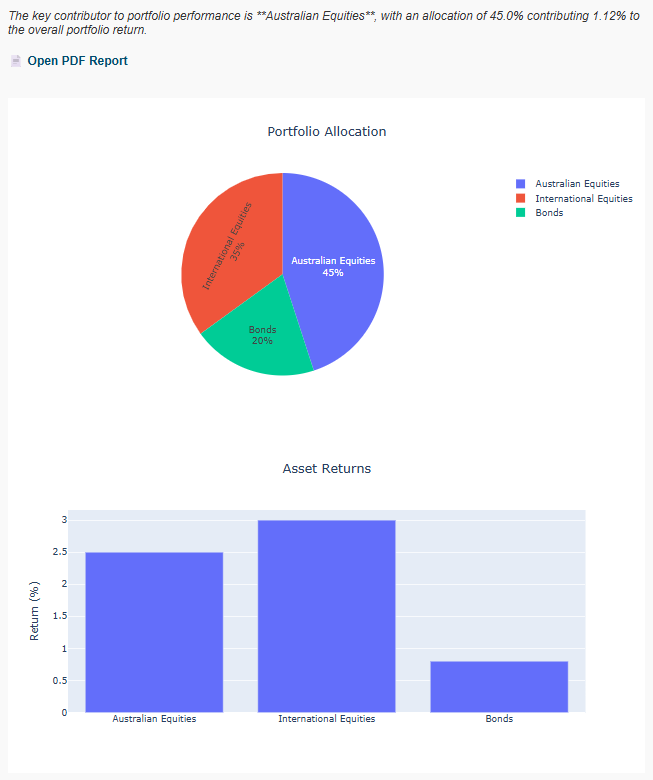
This demonstration represents only a simplified version of what is technically achievable. In practice, such a system can integrate with live portfolio management platforms, CRM databases or performance data feeds, enabling the automated generation of hundreds of client-specific reports simultaneously. Inputs could be drawn directly from custodial files, CSV or Excel data, or even APIs, removing the need for manual consolidation and cross-referencing.
Beyond core performance reporting, Python’s modular structure allows the inclusion of additional analytical layers, including:
- Risk metrics, such as volatility, drawdown and tracking error, which can be computed automatically and benchmarked across time periods or portfolios.
- Stress testing and scenario analysis, enabling advisers to demonstrate portfolio resilience under various market or macroeconomic conditions (e.g., interest rate shocks, currency movements or equity drawdowns).
- Compliance and mandate verification, ensuring asset allocations and exposures remain within agreed investment parameters.
- Attribution analysis, breaking down performance by sector, asset class or currency effect to provide clients with a more complete understanding of portfolio behaviour.
Each of these features can be configured to populate directly into pre-approved reporting templates, ensuring consistent visual identity, branding and disclosure language across all client materials. Importantly, because Python operates as an open-source and platform-independent framework, these solutions can be scaled or customised without reliance on proprietary software or ongoing licensing costs.
Operational advantages
Python’s integration potential with common data sources – including custodial platforms, CRM systems, and performance databases – means that data inputs can be standardised and refreshed automatically. The principal benefits to advice practices are threefold:
- Efficiency and scale: Report production time is reduced from hours to minutes, enabling staff to redirect focus toward client engagement and strategic analysis. Automated templates ensure uniformity across a large client base without incremental administrative effort.
- Accuracy and compliance: Automated workflows remove the risk of manual transcription or calculation errors, while maintaining version control and auditability – an increasingly important consideration under heightened regulatory expectations around client communication and record-keeping.
- Enhanced client experience: Dynamic visualisations and concise commentary elevate the professional quality of reports, allowing advisers to communicate investment outcomes and portfolio positioning with greater clarity. Clients receive information that is timely, consistent and visually comprehensible.
Beyond efficiency gains, the adoption of Python-based automation supports a broader strategic objective: positioning the practice as a data-enabled advisory business. This technological shift mirrors trends already established within institutional asset management, where Python underpins research, risk modelling and reporting infrastructure.
For financial advisers, this means moving away from repetitive administrative workflows and toward higher-value activities such as portfolio construction, macroeconomic interpretation and behavioural coaching. In effect, automation does not replace professional judgement; it enhances the adviser’s capacity to apply it where it has the greatest impact.
Automation within advice businesses is no longer an emerging concept but an operational necessity. Python provides a sophisticated yet accessible means to achieve this, combining analytical precision, visual presentation and workflow efficiency within a single framework.
By adopting automated reporting systems, advisers can improve consistency, enhance compliance confidence, and allocate more time to delivering meaningful, client-centred advice – a competitive advantage in an increasingly data-driven industry.
Ye Peng is a data scientist and developer at Atchison.